
Why This Playbook Matters
A mother of two has thought about a tummy tuck for months. One night she finally fills in a form on three surgeons’ websites.
Many practices take two days to call back. Many calls go to voicemail. The practice that answers first, and books the consult, usually gets the surgery.
Most plastic surgery practices lose patients in three places:
- They talk to every kind of patient, for every procedure, at the same time.
- They answer enquiries hours or days late.
- They stop talking to patients after the last post-op visit.
This playbook fixes those three places. Do the steps in order. Each step makes the next step work.
Cook does the work in each step. If a thing spends money or goes to a patient, it waits for YOU to approve it. See How to approve work.
What you will set up
- One procedure and one kind of patient to go after first, and one offer for them.
- A page that asks your first-call questions and collects the patient's number.
- Facebook and Instagram ads that follow Meta's rules for cosmetic surgery.
- A reply to every new enquiry within minutes, and a consult booked on your calendar.
- Steady patients from past patients and reviews, without ad spend.
Step 1: Choose the Patients You Want First
Why This Matters
A mother who wants a mommy makeover, a woman who wants a breast augmentation, and a patient who lost a lot of weight and now has loose skin ask different questions.
The first asks about recovery time with small children. The second asks about size and safety. The third asks if the result will last.
Pick ONE procedure group. Then the page, the ads and the follow-up all use the same words.
What to Do First
- Ask Cook’s Research department to compare two or three kinds of patient in your area. Ask what they worry about, what they search for, and what other practices offer them.
- Pick one group. Write your offer for them in one sentence, for example “A private consult with a board-certified surgeon, and a clear plan for cost and recovery.”
- Keep the other procedures for later. You can do this playbook again for each one.
I own a plastic surgery practice in Atlanta. Compare mommy makeover and tummy tuck patients, breast augmentation patients, and patients with loose skin after big weight loss: what they worry about, what other practices offer them, and which group I should go after first.
Cook writes the comparison. It also writes a one-page offer that you can change. These are the first tasks in a new workspace. See Why is everything locked? and the Research department.
What Cook Found for Magnolia Plastic Surgery
- Start with mommy makeover patients: Cook recommends you lead with mommy makeover and tummy tuck. Several Atlanta practices already package these procedures, so this gives a clear first test.
- Focus on post-pregnancy concerns: This group thinks about body changes after pregnancy and about recovery planning. Cook suggests a consultation offer that speaks to these two topics.
- Keep other groups separate: Test breast augmentation second, because local practices show its prices and implant education more openly. Keep body contouring after major weight loss as a specialist track, because it needs more detailed recovery and staging talks.
This is Cook’s real answer for a made-up Magnolia Plastic Surgery. Your answer depends on your area.
Step 2: Build a Page That Collects Patient Enquiries
Why This Matters
Your ads, your posts and your gallery all need one place to send people.
Patients research for a long time. They want a practice that feels calm and safe, not a discount flyer.
A good page does the first minutes of your call for you. It asks:
- which procedure the patient wants,
- how soon they want it,
- how to reach them.
When the enquiry comes in, you already know who to call first.
What to Do First
- Ask Cook for a page with a short quiz. Put one question on each screen. Then the patient can answer fast on a phone.
- Ask your first-call questions: which procedure, when they want surgery, how much recovery time they can take, if they want to know about financing, and their phone number.
- Keep the quiz to booking questions. Ask about health, weight and medical history at the consult, not on the page.
- Tell Cook what to do with a patient who is not ready, for example a person who plans surgery “in a year or more”. The quiz can send them to a different screen with your recovery guide, not to your calendar.
- Give Cook your surgeon’s name, board certification and licence and the exact disclaimer text you use. Cook puts them on the page.
- Read the page, then approve it. Cook puts it on the internet at a real web address. Cook can also make the photo and the logo.
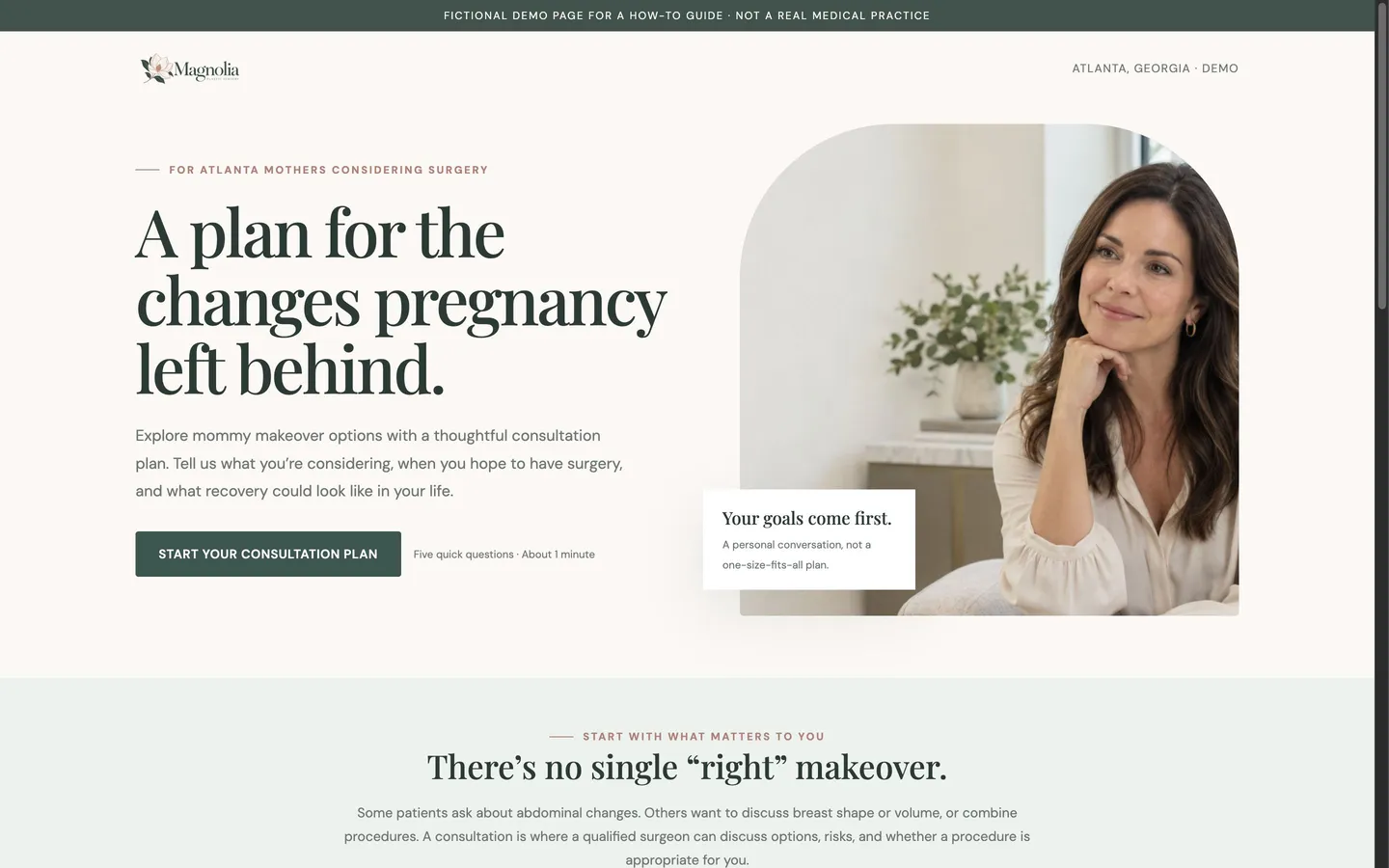
Build me a page for mommy makeover patients in Atlanta for Magnolia Plastic Surgery. Ask a few quick questions, one at a time: which procedures they want, when they want surgery, how much time off they can take, if they want financing details, and their phone number. If they plan surgery more than a year from now, send them my recovery guide. Put the surgeon’s name, board certification and licence number at the bottom.
More about pages and forms: Building a lead generating asset.
What the Patient Sees
Step 1 of 5
The Page Cook Built
Cook built this page from the request above, for a made-up business, Magnolia Plastic Surgery. Cook also made the photo and the logo.
Step 3: Run Facebook and Instagram Ads in the Right Category
Why This Matters
Meta has strict rules for cosmetic surgery. Breast augmentation, rhinoplasty, liposuction and other surgeries are on its list.
These ads must target people 18 or older. They must not say or show that something is wrong with how a person looks. They must not promise a set result in a set time.
Plastic surgery leads cost more than in most fields. A rejected ad wastes that money and brings no patients. So check the rules BEFORE the campaign starts, not after.
What to Do First
- Connect your Meta ad account to Cook. See Cook + Meta Ads.
- Ask Cook to write the ads and set up the campaign. Tell Cook to target ages 18 and older. Cook makes the campaign paused. Then it shows you an approval card with the budget and the ads.
- Check the special ad category on the approval card before you approve. If an ad offers financing or monthly payments from a lender, it is a credit offer. It goes in the financial products and services category.
- Want patients to stay inside Instagram? Ask for a Meta lead form, not a link to your page. Each form a patient sends becomes a lead in Cook. Your follow-up from Step 4 then starts by itself.
- Start with a small daily budget. Cook reads the results. It tells you which ads to stop and where to move the budget. You approve each change.
Write three Facebook ads for my mommy makeover page. Target women 18 and older within 40 miles of Atlanta. Talk about a private consult with a board-certified surgeon and a clear recovery plan. No discounts, and no words about flaws. Set up a campaign at $60 a day.
Before-and-after photos. Meta allows before-and-after photos for cosmetic surgery when the ad targets people 18 or older. Use real photos of your own patients, with their written consent. Do not add words that say the "before" body looked bad.
Google search ads. If you already run Google search ads, connect Google Ads so Cook can read your campaigns, keywords and spend. Cook does not make new Google search campaigns.
What Your Approval Card Shows
- Campaign
- Atlanta Mommy Makeover | 18+
- Daily budget
- $60
- Ages
- 18 and older
- Special ad category
- None (no financing offer)
- Starts
- Paused
Cook makes each campaign paused. Approving the card creates it, still paused. It starts only when you approve switching it on.
What Real Ads in This Industry Say
We read the Facebook and Instagram ads that 96 businesses like yours are running now, in Meta’s public Ad Library (October 12, 2026). Ads that run for months usually work, so start from what they repeat.
- Free or complimentary consultation. This is the most common offer, and it removes the first cost for the patient. “Schedule your free tummy tuck consultation today” (see the ad)
- Board certification up front. More than 12 ads state that the surgeon is board certified. “I am a board-certified plastic surgeon” (see the ad)
- Mommy Makeover with one recovery. Practices sell several procedures as one bundle with one recovery period. “combining them into one procedure gives you the best results with just one recovery period.” (see the ad)
The longest-running ad has run for almost 9 years. It offers a free tummy tuck consultation with a double board certified surgeon (see the ad).
Give these to Cook when you ask for ads, as research, not to copy.
Step 4: Answer Every Enquiry Within Minutes
Why This Matters
This step turns ad money into booked consults.
A patient who gets a text while they still hold their phone answers it.
A patient who hears back two days later has often booked with another surgeon. Your surgeon is in the operating room. The follow-up must not wait for them.
What to Do First
- Get a texting number. After you approve it, Cook files the carrier registration for you. See What phone numbers and texting cost.
- Set up a booking page for your consult, for example a 15-minute video call with your patient coordinator before the in-person consult. Add the hours that you are free. Cook sends the patient reminders before each appointment. To add a Zoom link to every booking, see Putting a Zoom link on every booking.
- Switch on the AI sales rep for new enquiries. It texts and emails each new patient in your words. It asks your questions, books the consult on your calendar, and follows up with patients who go quiet. See the Sales department.
- Keep the texts to booking. The sales rep does not say if a patient is a good candidate or what the surgery costs. Your surgeon decides that at the consult. Tell Cook this in your request.
- If you want, let the sales rep answer calls to your number. It answers the caller’s questions and books the consult.
- Test the follow-up routine before you switch it on. Ask for it as below, then press Test: Cook runs the full follow-up with a made-up patient. Then you can read EVERY message first.
When someone fills in my mommy makeover page, text them within two minutes. Ask when they hope to have surgery and if they have time off planned. Do not quote prices or say who is a candidate. Then book them on a 15-minute video call with my coordinator. If they don’t reply, email them the next day, and again a week later.
Nothing texts a patient until you switch it on. A follow-up you have just made is off. It waits until you turn it on yourself, and turning it off stops it at once. See Answering people without doing it yourself.
What the Patient Gets
Step 5: Stay in Touch With Past Patients and Grow Your Reviews
Why This Matters
A happy patient comes back for a second procedure. She tells her friends.
New patients read your reviews for months before they book.
Past patients cost you NO ad money, and they already trust you.
Old leads matter too. Many patients who enquired last year are ready now.
What to Do First
- Import your past patients and your old leads from a spreadsheet (CSV), or bring them in from GoHighLevel. See Cook + GoHighLevel.
- Give old leads a reason to talk again, for example open surgery dates next season. Cook writes the email or text. It shows it to you before it goes out.
- Ask for reviews. Ask Cook to text patients after their final post-op visit the link to your Google review page.
- Send one useful email each month, for example how to plan time off for recovery. To send from your own address, see Send email from your own domain.
- Post on a schedule. Connect Facebook, Instagram and your Google Business Profile. Cook writes and schedules the posts. You approve the schedule. See the Marketing department.
Here’s a spreadsheet of people who enquired in the last 18 months but never booked a consult. Email them that we have consult times open this month with Dr. Hayes, and ask if they still have questions. Show me the email before it goes out.
Check the Numbers Every Week
Each step above changes one number. Look at all of them once a week.
Then change one thing at a time.
Every Monday at 8am, send me last week’s numbers: new enquiries, consults booked, ad spend and cost per booked consult.
What a Month Can Look Like
These numbers are simulated. They are for a made-up practice, Magnolia Plastic Surgery, on a $60 a day budget. They show what your Monday report has in it. Your numbers depend on your area, your offer and your budget.
Final Thoughts
- Pick one procedure group. Write one offer for those patients.
- Build one page that asks your first-call questions.
- Run ads for people 18 and older. Follow Meta’s cosmetic rules. Start small.
- Answer EVERY enquiry within minutes. Book the consult while they are still interested.
- Stay in touch with past patients and old leads. Then patients come in without ad money.
Do the steps in this order. Each step gives the next step something to use:
- the page needs an offer,
- the ads need a page,
- the follow-up needs enquiries.
Run an agency with plastic surgery clients? Do these steps in each client’s workspace. See The Marketing Agency Playbook.