Why This Playbook Matters
A driver is hit on the freeway. Three days later, the neck pain starts and the insurance adjuster calls with an offer. That night, they fill in the case review form on three or four firm websites.
The firm that answers first usually gets the first talk. The first talk usually gets the signed case.
Most personal injury firms lose cases in three places:
- They talk to every kind of injured person at the same time.
- They answer enquiries hours late, while the ad money keeps spending.
- They stop talking to past clients and referral sources after the case settles.
This playbook fixes those three places. Do the steps in order. Each step makes the next step work.
Cook does the work in each step. If a thing spends money or goes to a potential client, it waits for YOU to approve it. See How to approve work.
What you will set up
- One kind of case to go after first, and one offer for those people.
- A page that asks your intake questions and collects the person's number.
- Facebook and Instagram ads with the wording your state bar requires.
- A reply to every new enquiry within minutes, and a consultation booked on your calendar.
- Steady cases from past clients, reviews and referral sources, without ad spend.
Step 1: Choose the Cases You Want First
Why This Matters
A car crash victim, a Spanish-speaking family after a work injury and a person who slipped in a store ask different questions.
The crash victim asks: the insurance company offered me $3,000, is that fair? The worker asks: can I lose my job? The store visitor asks: do I even have a case?
A page that talks to all of them does not answer any of them well. And broad ads bring the cases you do not want to take.
Pick ONE group. Then every later step is easier. The page, the ads and the follow-up all use the same words.
What to Do First
- Ask Cook’s Research department to compare two or three kinds of case in your area. Ask what those people worry about, what they search for, and what other firms offer them.
- Pick one group. Write your offer for them in one sentence.
- Keep the other groups for later. You can do this playbook again for each one.
I run a personal injury firm in Houston. Compare three groups in my area: people hurt in car crashes, Spanish-speaking people hurt in car or work accidents, and people hurt in slip-and-falls. Tell me what they worry about, what other firms offer them, and which group I should go after first.
Cook writes the comparison. It also writes a one-page offer that you can change. These are the first tasks in a new workspace. See Why is everything locked? and the Research department.
What Cook Found for Carver & Lane Injury Law
- Start with car-crash cases: Car-crash cases are the clearest first campaign. People can easily see themselves in an ad. Search interest for “Houston car accident lawyer” is up 130% over the past year, but this index does not count cases.
- What crash clients worry about: Car-crash clients may worry about medical bills, missed work, vehicle damage, fault, and insurer pressure. Houston firms commonly offer a free consultation, contingency fees, help with insurers, and trial preparation.
- Offer Spanish-first intake: Cook suggests visible Spanish-first intake across the firm. Screen workplace cases on a separate path because Texas employers are generally not required to carry workers’ compensation. Build slip-and-fall as the next campaign when the team can act fast to keep evidence.
This is Cook’s real answer for a made-up Carver & Lane Injury Law. Your answer depends on your area.
Step 2: Build a Page That Collects Case Enquiries
Why This Matters
Your ads, your posts and your referral sources all need one place to send people.
Injured people worry that a firm will sign them and then never call back. A clear page from a local attorney, with a real face and a real next step, earns the form.
A good page does the first minutes of your intake call for you. It asks:
- what happened and when,
- whether they already have a lawyer,
- how to reach them.
When the enquiry comes in, you already know which cases to call first.
What to Do First
- Ask Cook for a page with a short quiz. Put one question on each screen. Then an injured person can answer fast on a phone.
- Ask your intake questions: the kind of accident, when it happened, whether they got medical care, whether they already have a lawyer, and their phone number.
- Tell Cook what to do with a person you cannot help, for example a person who already has a lawyer, or an accident outside Texas. The quiz can send them to a different screen, not to your calendar.
- Give Cook the exact wording your state bar requires, for example an “Attorney Advertising” label, the name of the responsible attorney, and any text about past results. Cook puts it on the page.
- Do not promise a result. Ask Cook to avoid words like “guaranteed” or a dollar amount the person will get.
- Read the page, then approve it. Cook puts it on the internet at a real web address. Cook can make the photo and the logo.
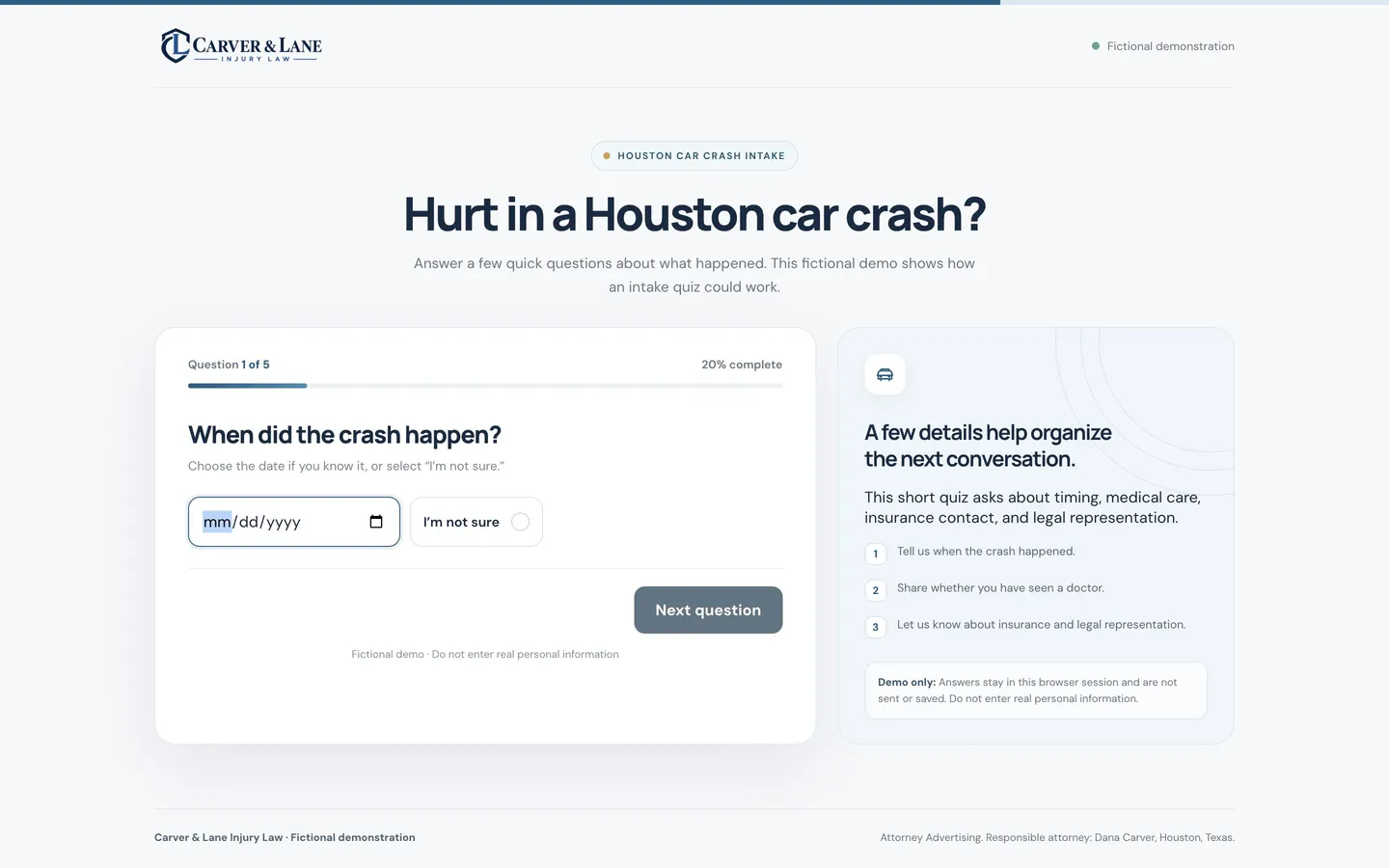
Build me a page for people hurt in car crashes in Houston. Ask a few quick questions, one at a time: when the crash happened, whether they went to a doctor, whether the insurance company has called them, whether they already have a lawyer, and their phone number. If they already have a lawyer, thank them and end the quiz. Put this text at the bottom of the page, word for word: “Attorney Advertising. Responsible attorney: Dana Carver, Houston, Texas.”
More about pages and forms: Building a lead generating asset.
What the Injured Person Sees
Step 1 of 5
The Page Cook Built
Cook built this page from the request above, for a made-up business, Carver & Lane Injury Law. Cook also made the photo and the logo.
Step 3: Run Facebook and Instagram Ads in the Right Category
Why This Matters
Meta has no special ad category for legal services. A personal injury ad that does not offer a loan or a job runs without one.
Your state bar has its own rules for lawyer ads. Some states require a label such as “Attorney Advertising”. Many states limit how you talk about past results. An ad that breaks those rules can put your licence in trouble, even if Meta runs it.
So put the bar’s wording in the ads BEFORE the campaign starts, not after.
What to Do First
- Connect your Meta ad account to Cook. See Cook + Meta Ads.
- Ask Cook to write the ads and set up the campaign. Cook makes the campaign paused. Then it shows you an approval card with the budget, the ads and the special ad category.
- Give Cook the same bar wording you gave for the page. Cook puts it in the ads.
- Check the special ad category on the approval card before you approve.
- Want people to stay inside Facebook? Ask for a Meta lead form, not a link to your page. Each form a person sends becomes a lead in Cook. Your follow-up from Step 4 then starts by itself.
- Start with a small daily budget. Cook reads the results. It tells you which ads to stop and where to move the budget. You approve each change.
Write three Facebook ads for my car crash page, for people in Harris County. Write one of them in Spanish, in plain everyday words, not a word for word translation. Put “Attorney Advertising. Responsible attorney: Dana Carver.” in every ad. Do not mention any past result. Set up a campaign at $60 a day.
Your state bar decides the wording, not Cook. Cook does not know your state's advertising rules. Give Cook the exact text your bar requires, and read every page and ad before you approve it. If your state asks you to file ads with the bar, do that before the campaign starts.
Google search ads. If you already run Google search ads, connect Google Ads so Cook can read your campaigns, keywords and spend. Cook does not make new Google search campaigns.
What Your Approval Card Shows
- Campaign
- Houston Car Crash Cases | EN + ES
- Daily budget
- $60
- Special ad category
- None
- Starts
- Paused
Cook makes each campaign paused. Approving the card creates it, still paused. It starts only when you approve switching it on.
What Real Ads in This Industry Say
We read the Facebook and Instagram ads that 99 businesses like yours are running now, in Meta’s public Ad Library (October 12, 2026). Ads that run for months usually work, so start from what they repeat.
- Offer a free case evaluation. This is the most common offer by far. “Contact us for a free case evaluation.” (see the ad)
- Open with “Injured in an accident?” About 15 ads start with this question. “Injured in an accident? Let me help.” (see the ad)
- Show the insurer works against them. Some ads speak with an insider voice about the insurance company. “the insurance company has experts working to minimize the compensation victims deserve.” (see the ad)
The longest-running ad is active for about 8 years, and it claims deep experience and millions recovered, offers a free consultation, and sends people to the firm’s website (see the ad).
Give these to Cook when you ask for ads, as research, not to copy.
Step 4: Answer Every Enquiry Within Minutes
Why This Matters
This step turns ad money into signed cases.
Each enquiry costs you real money. An injured person who gets a text while they still hold their phone answers it.
A person who hears back the next morning has often signed with the firm that called first.
What to Do First
- Get a texting number. After you approve it, Cook files the carrier registration for you. See What phone numbers and texting cost.
- Set up a booking page for your first call, for example a 20-minute free case review. Add the hours that you or your intake team are free. Cook sends the person reminders before the call. To add a Zoom link to every booking, see Putting a Zoom link on every booking.
- Switch on the AI sales rep for new enquiries. It texts and emails each new person in your words. It asks your intake questions, books the consultation on your calendar, and follows up with people who go quiet. See the Sales department.
- Tell the sales rep it does NOT give legal advice. It books the consultation. Questions like “do I have a case?” or “what is my case worth?” are for the attorney on the call.
- If you want, let the sales rep answer calls to your number. It answers the caller’s questions about your firm and books the consultation.
- Test the follow-up routine before you switch it on. Ask for it as below, then press Test: Cook runs the full follow-up with a made-up person. Then you can read EVERY message first.
When someone fills in my car crash page, text them within two minutes, in English or Spanish to match the form. Ask when the crash happened and if they have talked to the insurance company. Then book them on a 20-minute free case review with me. Never give legal advice or say what a case is worth; say the attorney will go over that on the call. If they don’t reply, email them the next day.
Nothing texts a potential client until you switch it on. A follow-up you have just made is off. It waits until you turn it on yourself, and turning it off stops it at once. See Answering people without doing it yourself.
What the Injured Person Gets
Step 5: Work Your Past Clients, Reviews and Referral Sources
Why This Matters
Injured people often say firms stopped returning their calls. A past client who was kept informed tells friends and family. Their review is what the next person reads before they fill in your form.
Chiropractors, body shops and other attorneys who do not take injury cases meet injured people every week.
These groups cost you NO ad money, and they already trust you.
What to Do First
- Import your past clients, your old enquiries and your referral sources from a spreadsheet (CSV), or bring them in from GoHighLevel. See Cook + GoHighLevel.
- Give them a reason to think of you, for example a short guide on what to do in the first week after a crash. Cook writes the email or text. It shows it to you before it goes out.
- Ask for reviews. Ask Cook to text your closed clients the link to your Google review page.
- Send one useful email each month to past clients and referral sources. To send from your own address, see Send email from your own domain.
- Post on a schedule. Connect Facebook, Instagram, LinkedIn and your Google Business Profile. Cook writes and schedules the posts, with the same bar wording. You approve the schedule. See the Marketing department.
Here’s a spreadsheet of my past clients whose cases closed. Email each one a short checklist: what to do in the first week after a car crash. Tell them they can send it to a friend, and they can call us any time. Put my Attorney Advertising line at the bottom. Show me the email before it goes out.
Check the Numbers Every Week
Each step above changes one number. Look at all of them once a week.
Then change one thing at a time.
Every Monday at 8am, send me last week’s numbers: new enquiries, case reviews booked, ad spend and cost per booked case review, in English and in Spanish.
What a Month Can Look Like
These numbers are simulated. They are for a made-up firm, Carver & Lane Injury Law, on a $60 a day budget. They show what your Monday report has in it. Your numbers depend on your area, your offer and your budget.
Final Thoughts
- Pick one case type. Write one offer for those people.
- Build one page that asks your intake questions and carries your bar wording.
- Run ads with the wording your state bar requires. Start small.
- Answer EVERY enquiry within minutes. Book the consultation and leave legal advice to the attorney.
- Stay in touch with past clients and referral sources. Then cases come in without ad money.
Do the steps in this order. Each step gives the next step something to use:
- the page needs an offer,
- the ads need a page,
- the follow-up needs enquiries.
Run an agency with law firm clients? Do these steps in each client’s workspace. See The Marketing Agency Playbook.