Why This Playbook Matters
A person is tired of contacts. They start a new job, plan a trip or lose a lens on a ski lift. Then they search for LASIK.
They read about dry eye, halos and clinics that rush people through. They want to know if they are a candidate before they talk to anyone. Often, they take two or three online quizzes in the same week.
The clinic that answers first, calmly and without pressure, usually gets the free exam. The exam usually gets the procedure.
Most LASIK clinics lose patients in three places:
- They talk to every kind of vision patient with the same words.
- They answer enquiries hours late, while the team is in clinic.
- They stop talking to people who had an exam but did not book.
This playbook fixes those three places. Do the steps in order. Each step makes the next step work.
Cook does the work in each step. If a thing spends money or goes to a patient, it waits for YOU to approve it. See How to approve work.
What you will set up
- One kind of vision patient to go after first, and one offer for them.
- A page that asks your first-call questions and collects the patient's number.
- Facebook and Instagram ads in the category Meta requires for your offer.
- A reply to every new enquiry within minutes, and a free exam booked on your calendar.
- Steady exams from optometrists, past patients and old consults, without ad spend.
Step 1: Choose the Patients You Want First
Why This Matters
A contact lens wearer in their 20s or 30s, a person who was told they are not a LASIK candidate, and a person over 50 who struggles to read ask different questions.
The contact lens wearer asks: am I a candidate, and is it safe? The person who was told no asks: is there another option for me? The older reader asks: does LASIK even help with this?
A page that talks to all of them does not answer any of them well.
Pick ONE group. Then every later step is easier. The page, the ads and the follow-up all use the same words.
What to Do First
- Ask Cook’s Research department to compare two or three kinds of vision patient in your area. Ask what they worry about, what they search for, and what other clinics offer them.
- Pick one group. Write your offer for them in one sentence, for example a free LASIK exam with the surgeon and a clear yes or no on candidacy.
- Keep the other groups for later. You can do this playbook again for each one.
I run a LASIK clinic in Denver. Compare contact lens wearers aged 25 to 40, people who were told they are not LASIK candidates, and people over 50 who struggle to read up close: what they worry about, what other clinics offer them, and which group I should go after first.
Cook writes the comparison. It also writes a one-page offer that you can change. These are the first tasks in a new workspace. See Why is everything locked? and the Research department.
What Cook Found for ClearView Eye Center
- Start with contact-lens wearers: Cook recommends a first test with contact-lens wearers aged 25–40. Their problem matches LASIK most directly, but the evidence does not prove they are the largest or best-converting group.
- Their main worries: This group worries about daily hassle, ongoing costs, pain, recovery, dry eye, and night vision. They also worry that they will still need glasses.
- The suggested message: Cook suggests this message: “Find out whether LASIK fits your eyes, then compare the full cost and alternatives.” The offer centers on a candidacy evaluation and makes no outcome or savings promise.
This is Cook’s real answer for a made-up ClearView Eye Center. Your answer depends on your area.
Step 2: Build a Page That Collects Patient Enquiries
Why This Matters
Your ads, your posts and your referring optometrists all need one place to send people.
A good page does the first minutes of your call for you. It asks:
- what the person is interested in,
- how soon they want it,
- how to reach them.
When the enquiry comes in, you already know who to call first.
What to Do First
- Ask Cook for a page with a short quiz. Put one question on each screen. Then the person can answer fast on a phone.
- Ask your first-call questions: LASIK, another option or not sure, when they would like the procedure, how they plan to pay (pay in full, monthly payments, HSA or FSA), weekday or Saturday, and their phone number.
- Keep the quiz to booking questions. The surgeon checks the eyes and the health history at the exam, not on the page or by text.
- Tell Cook what to do with a person who is not ready, for example a person who is just curious. The quiz can send them to a different screen, for example what happens at a free LASIK exam, not to your calendar.
- Give Cook the surgeon’s name, the medical licence number and the exact financing wording your lender requires, for example “for approved credit”. Cook puts them on the page.
- Read the page, then approve it. Cook puts it on the internet at a real web address. Cook can also make the photo and the logo.
Build me a page for contact lens wearers in Denver who are thinking about LASIK. Ask a few quick questions, one at a time: LASIK, another option or not sure, when would they like the procedure, how do they plan to pay, weekday or Saturday, and their phone number. If they are just curious, thank them and show them what happens at our free LASIK exam. Put Dr. Kim’s name and Colorado licence number, DR.0059876, at the bottom of the page.
More about pages and forms: Building a lead generating asset.
Cook does not say who is a candidate. It does not give medical advice or promise a result. Tell Cook to book the exam and to leave every question about the eyes, the risks and the result to the surgeon. Do not let the page or the ads promise 20/20 or perfect vision.
What the Patient Sees
Step 1 of 6
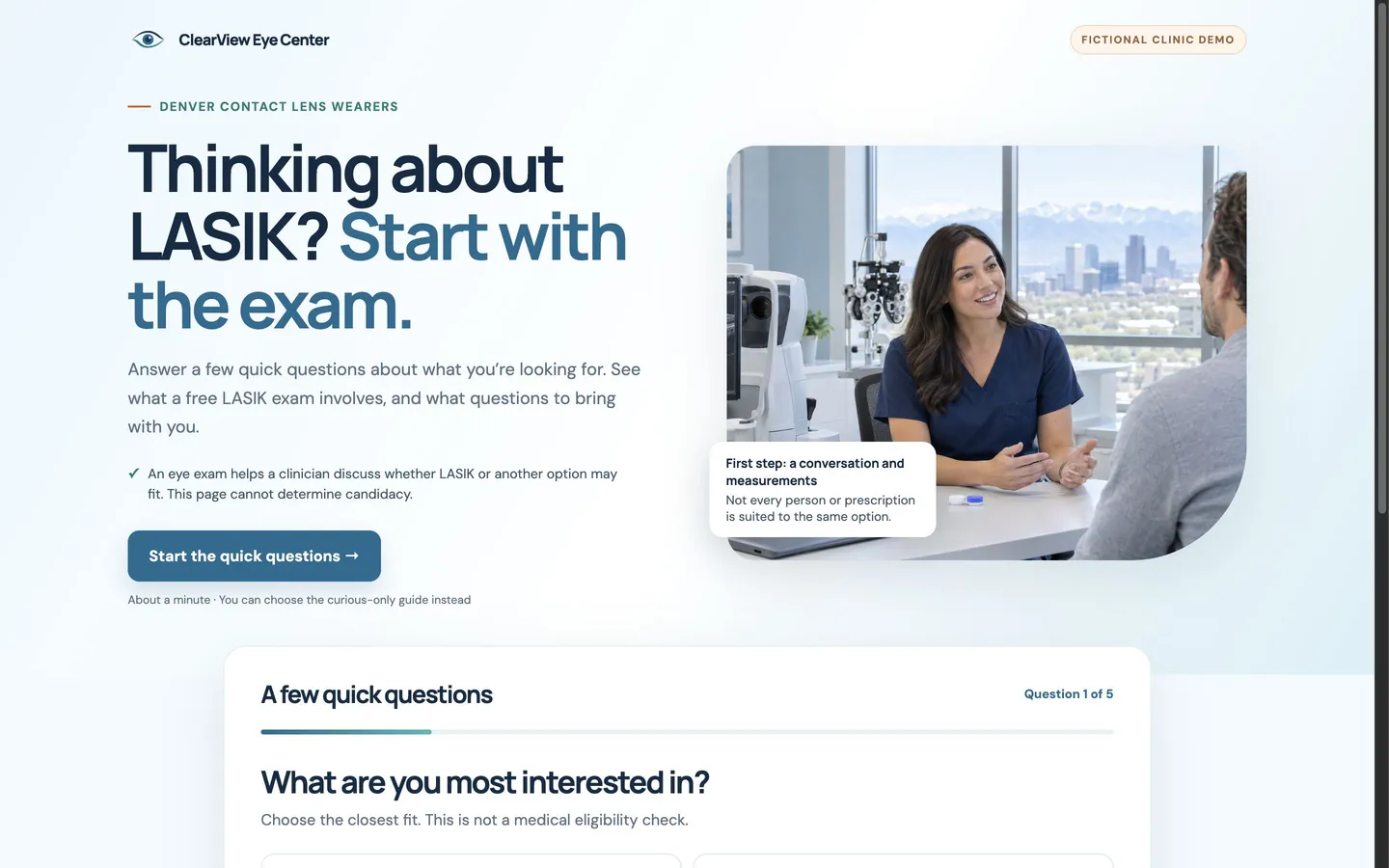
The Page Cook Built
Cook built this page from the request above, for a made-up business, ClearView Eye Center. Cook also made the photo and the logo.
Step 3: Run Facebook and Instagram Ads in the Right Category
Why This Matters
Many LASIK ads offer 0% financing or monthly payments. An ad that offers financing is a credit offer. Meta puts it in the financial products and services special ad category.
In that category, Meta limits how you target people by age, gender and location.
An ad in the wrong category can be rejected. A rejected ad brings no patients. So choose the category BEFORE the campaign starts, not after. If your ads do not offer financing, still check the special ad category on the approval card.
What to Do First
- Connect your Meta ad account to Cook. See Cook + Meta Ads.
- Ask Cook to write the ads and set up the campaign. Cook makes the campaign paused. Then it shows you an approval card with the budget, the ads and the special ad category.
- Show the surgeon and the exam, not a cheap price. People who fear a rushed clinic trust a surgeon who explains the risks.
- Check the special ad category on the approval card before you approve.
- Want patients to stay inside Facebook? Ask for a Meta lead form, not a link to your page. Each form a patient sends becomes a lead in Cook. Your follow-up from Step 4 then starts by itself.
- Start with a small daily budget. Cook reads the results. It tells you which ads to stop and where to move the budget. You approve each change.
Write three Facebook ads for my LASIK page. Show Dr. Kim at the exam and offer a free LASIK exam. One ad says 0% financing for 24 months, for approved credit, so put the campaign in the financial products and services special ad category. Set it up at $45 a day.
Google search ads. If you already run Google search ads, connect Google Ads so Cook can read your campaigns, keywords and spend. Cook does not make new Google search campaigns.
What Your Approval Card Shows
- Campaign
- Denver Free LASIK Exam | Financing
- Daily budget
- $45
- Special ad category
- FINANCIAL PRODUCTS AND SERVICES
- Starts
- Paused
Cook makes each campaign paused. Approving the card creates it, still paused. It starts only when you approve switching it on.
What Real Ads in This Industry Say
We read the Facebook and Instagram ads that 78 businesses like yours are running now, in Meta’s public Ad Library (October 12, 2026). Ads that run for months usually work, so start from what they repeat.
- Free consultation as first step. This is the most common offer, and it makes the first visit feel low risk. “Take the first step toward clear vision by scheduling a free consultation.” (see the ad)
- Implant for non-LASIK candidates. Many clinics offer EVO ICL to people who cannot have LASIK or do not want a laser. “Not everyone is meant for LASIK… and that’s where this changes everything” (see the ad)
- Morning glasses pain point. Several ads open with the daily moment when a person reaches for glasses. “Still waking up reaching for glasses?” (see the ad)
The longest-running ad has run for almost 5 years, and it sends people to a blog post about how to pay for LASIK (see the ad).
Give these to Cook when you ask for ads, as research, not to copy.
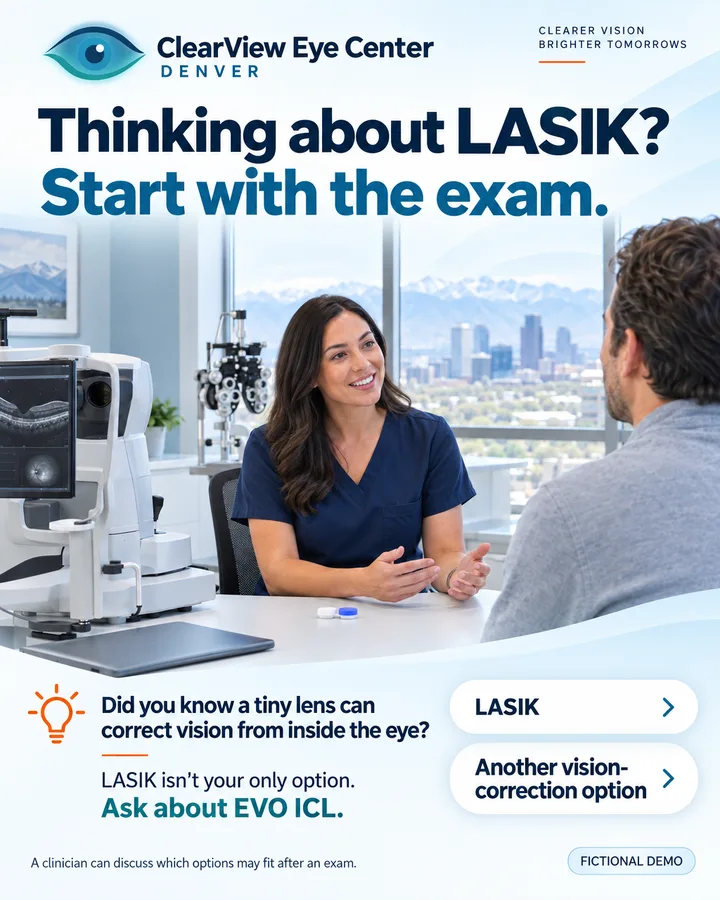
The Ads Cook Made for ClearView Eye Center
Cook made these ads from the page after reading the real ads above. Each ad uses the page’s photo, colours and headline.

Step 4: Answer Every Enquiry Within Minutes
Why This Matters
This step turns ad money into exams.
A person who gets a text while they still hold their phone answers it.
A person who hears back the next day has often booked a free exam at another clinic already. A pushy call makes them think of a LASIK mill. A calm text and an easy booking do not.
What to Do First
- Get a texting number. After you approve it, Cook files the carrier registration for you. See What phone numbers and texting cost.
- Set up a booking page for your free exam, for example a 90-minute visit. Add the hours that you are free, including Saturdays if you open then. Cook sends the patient reminders before the exam. If you also do short video calls first, see Putting a Zoom link on every booking.
- Switch on the AI sales rep for new enquiries. It texts and emails each new patient in your words. It asks your questions, books the exam on your calendar, and follows up with people who go quiet. See the Sales department.
- If you want, let the sales rep answer calls to your number. It answers the caller’s questions and books the exam. It does not say who is a candidate or what the procedure costs for them. The surgeon does that at the exam.
- Test the follow-up routine before you switch it on. Ask for it as below, then press Test: Cook runs the full follow-up with a made-up patient. Then you can read EVERY message first.
When someone fills in my LASIK page, text them within two minutes. Thank them, ask if a weekday or a Saturday is better, and book a free 90-minute exam with Dr. Kim. Do not answer medical questions or promise results, tell them Dr. Kim goes over that at the exam, with no pressure to book. If they don’t reply, email them the next day.
Nothing texts a patient until you switch it on. A follow-up you have just made is off. It waits until you turn it on yourself, and turning it off stops it at once. See Answering people without doing it yourself.
What the Patient Gets
Step 5: Work Your Optometrists, Past Patients and Old Consults
Why This Matters
People who fear a bad clinic ask their eye doctor and their friends first. Optometrists who trust you send patients for years.
Past patients tell their friends and coworkers. Their reviews answer the fear of a LASIK mill.
People who had an exam but did not book often still want it. They were waiting for their HSA, their FSA or their tax refund.
These groups cost you NO ad money, and they already know you.
What to Do First
- Import your past patients, your old consults and your referring optometrists from a spreadsheet (CSV), or bring them in from GoHighLevel. See Cook + GoHighLevel.
- Give old consults a reason to talk again, for example a new HSA or FSA year, or your financing options. Cook writes the email or text. It shows it to you before it goes out.
- Ask for reviews. After a patient’s follow-up visit, ask Cook to text them the link to your Google review page.
- Send one useful email each month to referring optometrists, for example the patients you treated together and how to send the next one. To send from your own address, see Send email from your own domain.
- Post on a schedule. Connect Facebook, Instagram, LinkedIn and your Google Business Profile. Cook writes and schedules posts where Dr. Kim answers common questions, and patient stories you have permission to share. You approve the schedule. See the Marketing department.
Here’s a spreadsheet of people who had a free LASIK exam in the last 18 months but did not book. Email them in early January. Tell them a new HSA or FSA year has started, and offer a short call to go over their options. Show me the email before it goes out.
Check the Numbers Every Week
Each step above changes one number. Look at all of them once a week.
Then change one thing at a time.
Every Monday at 8am, send me last week’s numbers: new enquiries, exams booked, ad spend and cost per booked exam.
What a Month Can Look Like
These numbers are simulated. They are for a made-up clinic, ClearView Eye Center in Denver, on a $45 a day budget. They show what your Monday report has in it. Your numbers depend on your area, your offer and your budget.
Final Thoughts
- Pick one patient group. Write one offer for them.
- Build one page that asks your first-call questions.
- Run ads in the right special ad category. Financing offers go in financial products and services. Start small.
- Answer EVERY enquiry within minutes. Book the exam while they are still interested.
- Stay in touch with optometrists, past patients and old consults. Then exams come in without ad money.
Do the steps in this order. Each step gives the next step something to use:
- the page needs an offer,
- the ads need a page,
- the follow-up needs enquiries.
Run an agency with LASIK clients? Do these steps in each client’s workspace. See The Marketing Agency Playbook.