Why This Playbook Matters
After a heavy rain, a homeowner finds water on the basement floor. Or they see a long crack in the wall. They are scared, and they are suspicious.
Many have heard of a salesman who scared a family about black mold, or a $25,000 repair that had to happen “tomorrow”. So they want a clear, calm inspection and an estimate they can check.
Most waterproofing and foundation owners lose jobs in three places:
- They talk to every kind of homeowner at the same time.
- They answer enquiries hours late, after the rain has stopped and the worry has faded.
- They stop talking to people after the estimate, so old estimates never turn into jobs.
This playbook fixes those three places. Do the steps in order. Each step makes the next step work.
Cook does the work in each step. If a thing spends money or goes to a homeowner, it waits for YOU to approve it. See How to approve work.
What you will set up
- One kind of homeowner to go after first, and one offer for them.
- A page that asks your first-call questions and collects the homeowner's number.
- Facebook and Instagram ads for inspections, in the right category.
- A reply to every new enquiry within minutes, and an inspection booked on your calendar.
- Steady jobs from old estimates, past customers and reviews, without ad spend.
Step 1: Choose the Homeowners You Want First
Why This Matters
A homeowner with a wet basement, a homeowner with a cracked or bowing wall, and a homeowner whose sump pump keeps failing ask different questions.
A page that talks to all of them does not answer any of them well.
Pick ONE group. Then every later step is easier. The page, the ads and the follow-up all use the same words.
What to Do First
- Ask Cook’s Research department to compare two or three kinds of homeowner in your area. Ask what they worry about, what they search for, and what other waterproofing companies offer them.
- Pick one group. Write your offer for them in one sentence. For example: a basement inspection with photos, a written estimate, and no pressure to sign the same day.
- Keep the other groups for later. You can do this playbook again for each one.
I run DryRock Foundation Repair in Cincinnati. Compare homeowners with a wet basement, homeowners with cracked or bowing basement walls, and homeowners with sump pump problems: what they worry about, what other companies offer them, and which group I should go after first.
Cook writes the comparison. It also writes a one-page offer that you can change. These are the first tasks in a new workspace. See Why is everything locked? and the Research department.
What Cook Found for DryRock Foundation Repair
- Start with wet basement homeowners: Cook says to test homeowners who see water, dampness, or recurring seepage first. The problem is easy to recognize, and Cincinnati-area pages offer matching inspection, waterproofing, drainage, and sump services.
- Wall owners fear movement: Homeowners with cracked or bowing walls want to know if the wall is moving and how serious it is. Cook says not to judge severity from a photo or suggest that every crack means structural failure.
- One shared inspection offer: Cook suggests one inspection offer with three messages for wet basements, wall movement, and sump pumps. Lead with diagnosis, then send each homeowner to the right service.
This is Cook’s real answer for a made-up DryRock Foundation Repair. Your answer depends on your area.
Step 2: Build a Page That Collects Homeowner Enquiries
Why This Matters
Your ads, your posts and your past customers all need one place to send people.
Homeowners fear a scare-tactic inspection and a huge quote. A calm page that says what happens at the inspection helps them book. It also does the first minutes of your call for you. It asks:
- what they see,
- when it happens,
- how to reach them.
When the enquiry comes in, you already know who to call first.
What to Do First
- Ask Cook for a page with a short quiz. Put one question on each screen. Then the homeowner can answer fast on a phone.
- Ask your first-call questions: what they see (water on the floor, damp walls, cracks, a bowing wall, a failing sump pump), when it happens (after rain, all the time), finished or unfinished basement, own or rent, the ZIP code, when they want the inspection, and their phone number.
- Tell Cook what to do with a person who is not ready, for example a buyer who does not own the home yet. The quiz can send them to a different screen, not to your calendar.
- Give Cook your contractor licence number and the exact text you want at the bottom of the page. Cook puts it on the page.
- Read the page, then approve it. Cook puts it on the internet at a real web address. Cook can make the photo and the logo too.
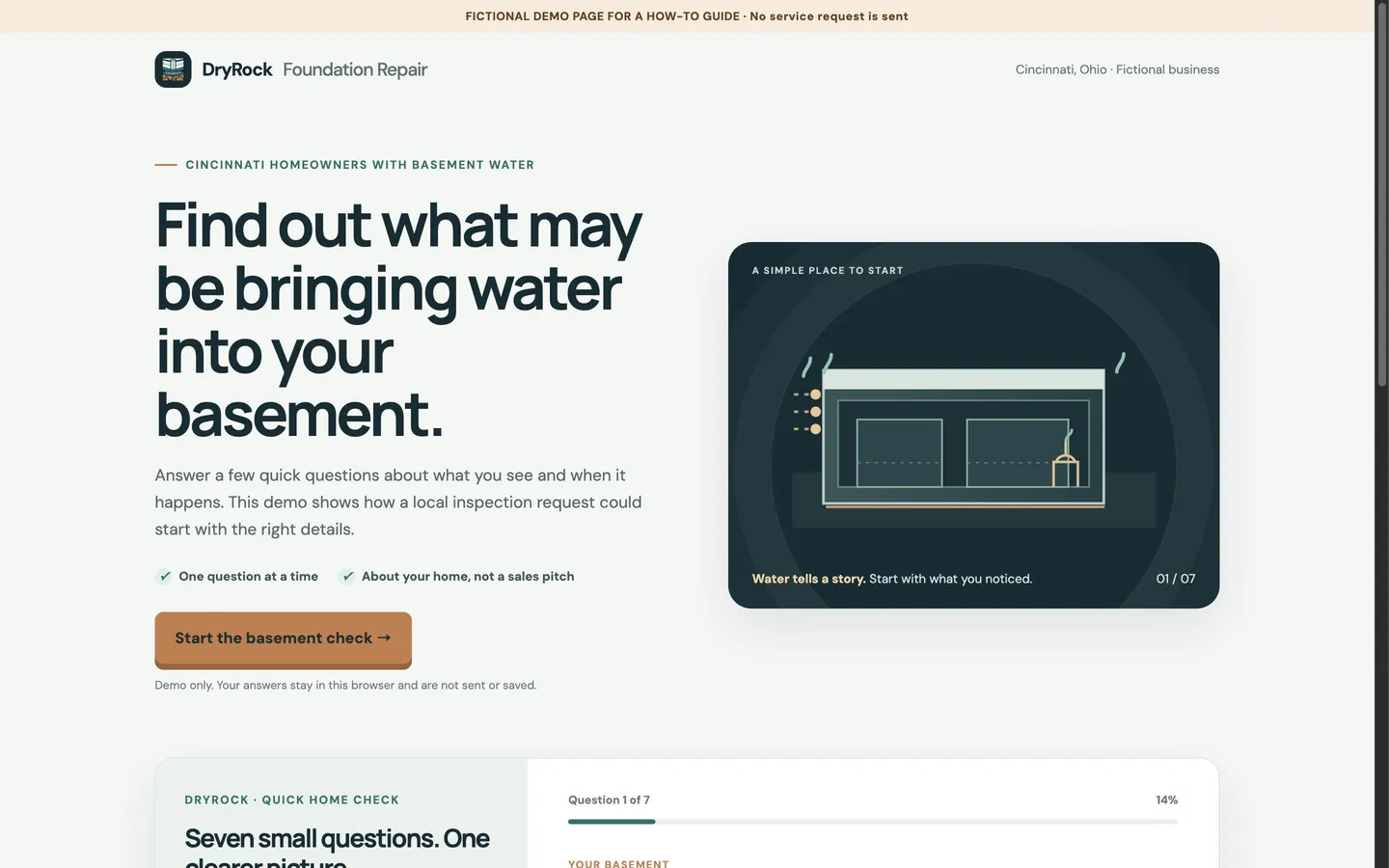
Build me a page for Cincinnati homeowners with a wet basement. Ask a few quick questions, one at a time: what they see, when it happens, is the basement finished, do they own the home, their ZIP code, when they want an inspection, and their phone number. If they don’t own the home yet, thank them and send them my checklist for buying a home with a basement. Put my licence number at the bottom of the page.
More about pages and forms: Building a lead generating asset.
What the Homeowner Sees
Step 1 of 7
The Page Cook Built
Cook built this page from the request above, for a made-up business, DryRock Foundation Repair. Cook also made the photo and the logo.
Step 3: Run Facebook and Instagram Ads in the Right Category
Why This Matters
A person with water coming in right now searches on Google. Facebook and Instagram ads fit the inspection best: for homeowners with a damp basement or a crack they have watched for months.
Waterproofing and foundation jobs cost a lot, so many companies offer financing. An ad that offers financing, for example “low monthly payments”, is a credit offer. It goes in the financial products and services special ad category. In that category, Meta limits how you target people by age, gender and location. An ad in the wrong category can be rejected, and a rejected ad brings no homeowners.
What to Do First
- Connect your Meta ad account to Cook. See Cook + Meta Ads.
- Ask Cook to write the ads and set up the campaign. Cook makes the campaign paused. Then it shows you an approval card with the budget, the ads and the special ad category.
- Check the special ad category on the approval card before you approve. If an ad mentions financing, use the financial products and services category.
- Want homeowners to stay inside Facebook? Ask for a Meta lead form, not a link to your page. Each form a homeowner sends becomes a lead in Cook. Your follow-up from Step 4 then starts by itself.
- Start with a small daily budget. Cook reads the results. It tells you which ads to stop and where to move the budget. You approve each change.
Write three Facebook ads for my wet basement page. Keep them calm: no scare words about mold. One ad mentions financing, so put the campaign in the financial products and services special ad category. Set it up at $40 a day for homeowners around Cincinnati.
Google search ads. If you already run Google search ads, connect Google Ads so Cook can read your campaigns, keywords and spend. Cook does not make new Google search campaigns.
Local Services Ads stay with you. Many wet-basement calls after a storm come from Google search and Local Services Ads. Cook does not create Local Services or search campaigns. Keep running them yourself. Cook reads your Google Ads results, and Cook answers the enquiries that come in.
What Your Approval Card Shows
- Campaign
- Cincinnati Basement Inspections | Financing
- Daily budget
- $40
- Special ad category
- FINANCIAL PRODUCTS AND SERVICES
- Starts
- Paused
Cook makes each campaign paused. Approving the card creates it, still paused. It starts only when you approve switching it on.
What Real Ads in This Industry Say
We read the Facebook and Instagram ads that 61 businesses like yours run now, in Meta’s public Ad Library (October 12, 2026). Ads that run for months usually work, so start from what they repeat.
- Offer a free inspection. This is the most common offer, and some ads add photos or a written report. “Free Crawl Space Inspections with photos!” (see the ad)
- Show your years in business. Many ads lead with tenure or family ownership. “48 Years In Business” (see the ad)
- Ask about the symptom. The ad names a sign that the homeowner can see. “Cracks in Your Walls?” (see the ad)
The longest-running ad runs for about 7 years, and it uses only a short line with the service and the city and a Call now button (see the ad).
Give these to Cook when you ask for ads, as research, not to copy.
Step 4: Answer Every Enquiry Within Minutes
Why This Matters
This step turns ad money into booked inspections.
A homeowner who gets a text while the water is still on the floor answers it.
A homeowner who hears back two days later has often stopped worrying, or booked another company.
What to Do First
- Get a texting number. After you approve it, Cook files the carrier registration for you. See What phone numbers and texting cost.
- Set up a booking page for your inspection, for example a one-hour basement inspection. Add the hours that you are free. Cook sends the homeowner reminders before the visit. To add a Zoom link for a video call first, see Putting a Zoom link on every booking.
- Switch on the AI sales rep for new enquiries. It texts and emails each new homeowner in your words. It asks your questions, books the inspection on your calendar, and follows up with homeowners who go quiet. See the Sales department.
- If you want, let the sales rep answer calls to your number. It answers the caller’s questions and books the inspection.
- Tell Cook what the sales rep must NOT do. It does not say what is wrong with the foundation or give prices. You do that at the inspection. Cook does not dispatch crews or quote jobs.
- Test the follow-up routine before you switch it on. Ask for it as below, then press Test: Cook runs the full follow-up with a made-up homeowner. Then you can read EVERY message first.
When someone fills in my wet basement page, text them within two minutes. Ask when the water comes in. Then book them on a one-hour inspection. Don’t give prices or say what is wrong by text. If they don’t reply, email them the next day.
Nothing texts a homeowner until you switch it on. A follow-up you have just made is off. It waits until you turn it on yourself, and turning it off stops it at once. See Answering people without doing it yourself.
What the Homeowner Gets
Step 5: Work Your Old Estimates, Past Customers and Reviews
Why This Matters
Many homeowners get an estimate and then wait. The next heavy rain brings the worry back.
Your past customers tell their neighbours. And new homeowners read reviews to check that you are not a scare-tactic company, so real reviews matter a lot.
These people cost you NO ad money, and they already know you.
Most companies lose them because nobody keeps in touch after the estimate or the job.
What to Do First
- Import your old estimates and your past customers from a spreadsheet (CSV), or bring them in from GoHighLevel. See Cook + GoHighLevel.
- Give them a reason to talk again, for example a check-in before the spring rains, or a sump pump check for past customers. Cook writes the email or text. It shows it to you before it goes out.
- Ask for reviews. Ask Cook to text your finished customers the link to your Google review page.
- Send one useful email each month, for example how to keep gutters and downspouts from flooding a basement. To send from your own address, see Send email from your own domain.
- Post on a schedule. Connect Facebook, Instagram and your Google Business Profile. Cook writes and schedules the posts, for example before-and-after photos of a dry basement. You approve the schedule. See the Marketing department.
Here’s a spreadsheet of everyone who got an estimate from us last year but did not book. Text them before the spring rains. Ask if the water came back and offer a free second look. Show me the text before it goes out.
Check the Numbers Every Week
Each step above changes one number. Look at all of them once a week.
Then change one thing at a time.
Every Monday at 8am, send me last week’s numbers: new enquiries, inspections booked, ad spend and cost per booked inspection.
What a Month Can Look Like
These numbers are simulated. They are for a made-up waterproofing and foundation company, DryRock Foundation Repair, on a $40 a day budget. They show what your Monday report has in it. Your numbers depend on your area, the weather, your offer and your budget.
Final Thoughts
- Pick one homeowner group. Write one offer for them.
- Build one page that asks your first-call questions.
- Run Meta ads for inspections. Use the financial products and services category when an ad offers financing. Start small.
- Answer EVERY enquiry within minutes. Book the inspection while they are still worried.
- Follow up old estimates and ask for reviews. Then jobs come in without ad money.
Do the steps in this order. Each step gives the next step something to use:
- the page needs an offer,
- the ads need a page,
- the follow-up needs enquiries.
Run an agency with waterproofing and foundation repair clients? Do these steps in each client’s workspace. See The Marketing Agency Playbook.