Media Buying Is Dead. Here's What Replaced It.
Meta's Andromeda AI retrieval system changed everything. The old playbook of manual targeting, bid tweaking, and ad variations is dead. In 2026, creative diversification is the only lever that matters.
Let's say the quiet part out loud.
If your job title is "Media Buyer" and your primary skill is setting up campaigns in Ads Manager, testing interest-based audiences, and adjusting CPM bids — you are being automated out of a job.
Not in five years. Now.
The writing has been on the wall since Meta launched Advantage+ in 2022. But in 2026, with the rollout of Andromeda — Meta's new AI-powered ad retrieval system — the wall itself has been demolished and rebuilt as an AI pipeline.
What "Media Buying" Actually Meant
For the last decade, "media buying" meant a specific set of manual tasks:
- Campaign setup — choosing objectives, placements, budgets
- Audience targeting — building interest stacks, lookalikes, custom audiences
- Bid management — setting cost caps, bid caps, adjusting delivery
- Creative testing — uploading variations, monitoring performance, killing losers
- Reporting — pulling data, building dashboards, presenting to clients
- Scaling — duplicating winning ad sets, increasing budgets, managing frequency
Agencies charged $2,000-$10,000/month for this. Freelancers billed $50-$150/hour. Media buying courses sold for $997-$4,997.
And every single one of those six tasks is now handled by AI.
How Meta Killed Its Own Ecosystem
The irony is that Meta itself killed the media buyer role. Not competitors. Not regulation. Meta.
Advantage+ Shopping Campaigns
Advantage+ doesn't let you pick audiences. It doesn't let you choose placements. It barely lets you set bids. You give it a product catalog, a budget, and creative assets — and it figures out the rest.
Meta's internal data shows Advantage+ campaigns outperform manual campaigns by 17-32% on average cost per acquisition. The machine is better at targeting than you are. It has more data. It processes faster. It doesn't sleep.
Broad Targeting Dominance
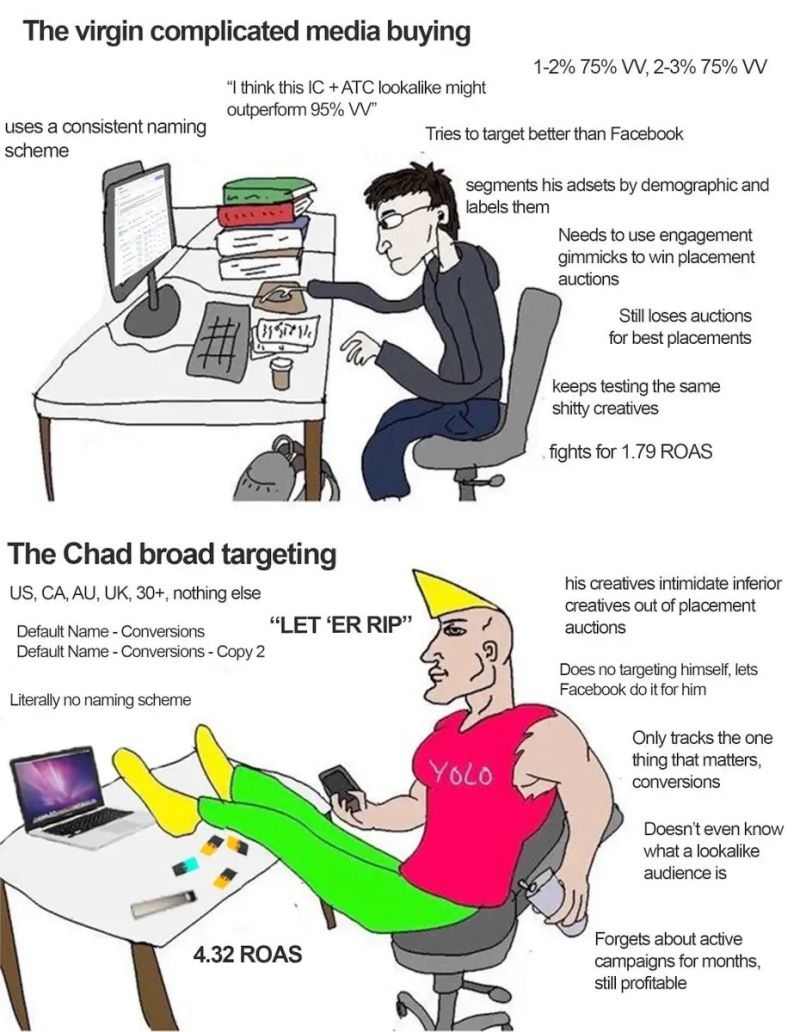
The old playbook was: build a detailed audience, test it, iterate. The new playbook is: go broad, let the algorithm find buyers.
Interest-based targeting is effectively deprecated. Lookalike audiences are a rounding error. The algorithm knows your customers better than your audience research spreadsheet does.
The technical skill of "audience building" has zero value in 2026.
Enter Andromeda: The New Rules of Meta Advertising
For years, the game on Meta was about precision targeting. We obsessed over demographics, interests, and behaviors, trying to find that perfect narrow audience.
That era is over.
Meta's new AI-powered ad retrieval system, Andromeda, has fundamentally changed the rules. And if you don't understand how it works, you're leaving money on the table.
From Targeting to Creative
Meta has made a clear and decisive shift in strategy. Their own research and public statements confirm it:
"The biggest constraint you can put on your Meta strategy is the constraints you place on your creative process."
That's a direct quote from Meta's business blog. They are telling us, in no uncertain terms, that the advertisers who provide the most diverse and high-quality creative will win. Not the ones with the best audiences. Not the ones with the cleverest bid strategies. The ones with the best creative pipeline.
The Old Way Is Dying
This is what used to work when launching new ads:
- 5 hooks for 1 body
- Find a winner? Print more hooks on the same body — extremely similar
This approach is gradually dying. Not to say it won't work at all, but the probability of it working is a lot lower than it used to be.
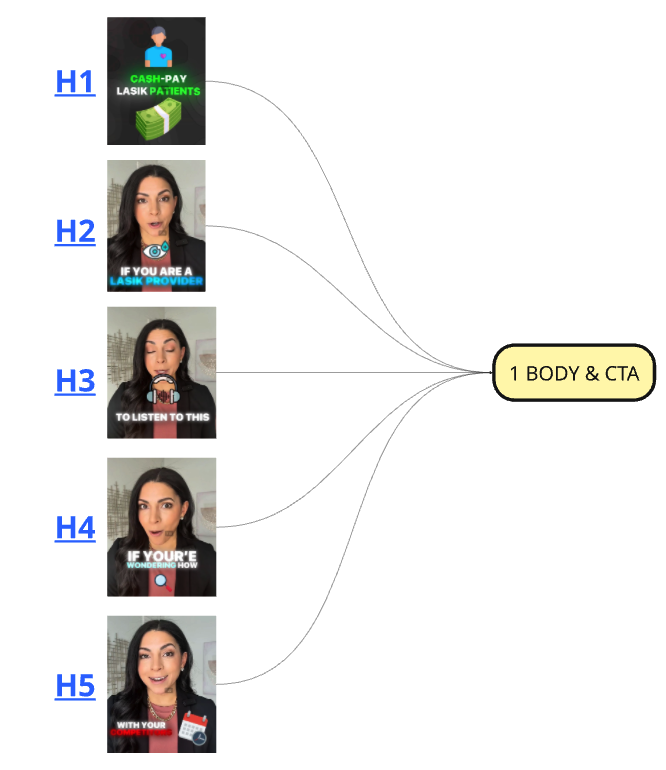
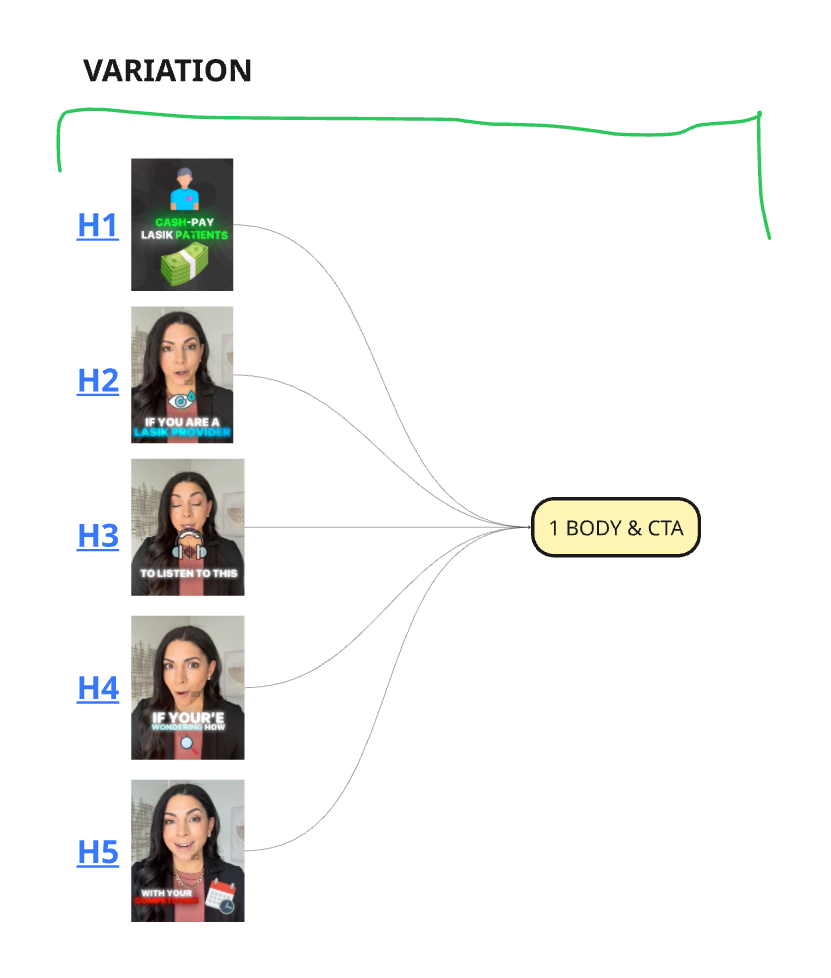
This was the "lazy way" of advertising. Now we're moving towards a world where the people who know how to pump out mass amounts of diverse creative will win.
Which is great news if you have the right tools — because most people are too lazy to do it.
How Andromeda Actually Works
To understand how to win with Andromeda, you need to understand how Meta delivers ads. It's a four-step process that happens instantly:
- Retrieval — Andromeda sifts through tens of millions of ads and filters them down to a few thousand that are generally relevant. This is the most data-intensive part.
- Light Ranking — The thousands of ads get ranked and filtered down to a few hundred.
- Final Scoring — The hundreds of ads get scored based on their "total predicted advertiser value."
- Auction — The top-scoring ads compete for the impression.
Andromeda's biggest impact is on the retrieval stage. Because of the explosion of AI-generated ad creatives, Meta needed a much more powerful system to handle the sheer volume. People are now producing significantly more ads using AI, and Meta had to develop an entirely new system of sorting through them because the volume was becoming too much to handle and the old algorithm was becoming wildly inefficient.
The Total Value Formula
To win the final auction, your ad needs the highest "total value." Meta calculates this as:
Total Value = (Advertiser Bid x Estimated Action Rates) + User Experience
- Advertiser Bid — Your bid in the auction. If you use auto-bidding, Meta handles this.
- Estimated Action Rates — A combination of soft metrics (CTR, CPC, CPMs) and hard metrics (click-to-conversion rate).
- User Experience — Quality of your ad and landing page. Poor reviews or slow pages = penalized with higher CPMs.
This formula proves that winning the auction is not just about having the highest bid. It's about having a high-quality ad that is likely to get a response.
The Creative IS the Targeting
This is the single most important concept to understand in the age of Andromeda.
For years, we thought of creative and targeting as two separate disciplines. That's no longer the case. The creative is the targeting.
Meta's AI analyzes every single element of your ad creative to determine who to show it to. It looks at the colors, the text, the icons, the ad copy. It feeds everything through sentiment analysis. It takes every piece of information and uses that to power the targeting.
If you want to target a specific audience, you need to create an ad that speaks directly to them. The old days of complex targeting rules and interest-based audiences are over. The algorithm is smart enough to find the right audience for your ad — as long as you give it the right creative to work with.
New Concepts Over Variations
This is where most advertisers get it catastrophically wrong.
There's a massive difference between a "new concept" and a "variation":
- New Concept — A completely new ad format (e.g., VSL to static image), a new marketing angle, or a new target audience.
- Variation — A small tweak to an existing ad: new hook, new thumbnail, different call to action.
With Andromeda, Meta groups similar ads together. If you're just testing variations, you're not giving the algorithm enough unique signals to work with. You need to test new concepts to truly understand what resonates.
The Streaming Service Analogy
Imagine you're creating a new streaming service called "Netflix for Old Men." You start with the assumption that old men like 1900s war films. You launch with a library of black-and-white war films. You get traction with one particular film.
The old way of thinking: create a variation. Take that successful war film, change the name, release a colorized version. To Andromeda, this is still the same basic ad. It's just a slight variation on a theme it already understands.
The new way of thinking: realize these old men might also enjoy drama movies. That's a completely different genre — a totally new idea you hadn't considered. By adding a drama film, you're giving the algorithm a brand new, unique creative to test. You're diversifying your content library in a meaningful way.
If you don't capitalize on new concepts and keep sticking with variations, you'll leave easy money on the table by missing out on a huge chunk of the market who don't care about war films.
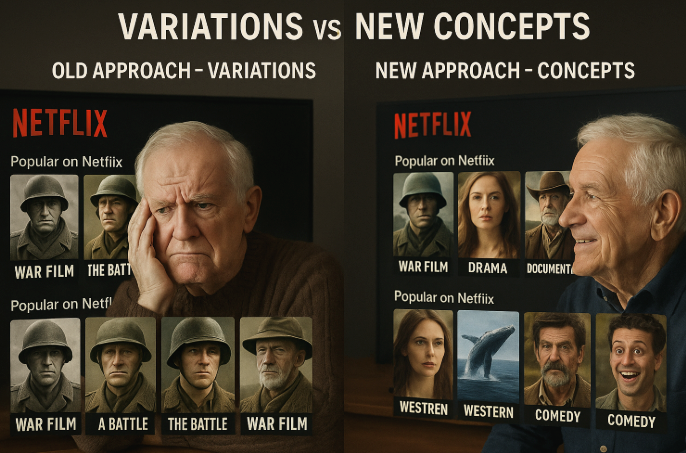
Diversification: Look vs. Messaging
Creative diversification breaks down into two types:
- Diversification in the LOOK — setting, environment, person, format, layout
- Diversification in the MESSAGING — angle, pain point, desire, selling proposition
Messaging is the most important one. You can change the background, swap the model, use a different font — but if the core message is the same, Andromeda groups it together. Change the reason someone would buy, and now you have a genuinely new concept.
Real-World Examples: Concepts vs. Variations
Example 1: Dog Food Brand
Imagine you're selling high-end dog food. The old way: create one ad and test variations. The new way: brainstorm every reason someone would buy and create a unique ad for each.
| New Concept (Unique Angle) | Variation (Slight Tweak) |
|---|---|
| It's frozen, so it's fresher | Same ad, different dog breed |
| It's healthier with human-grade ingredients | Same ad, different background color |
| It doesn't smell like other dog food | Same ad, different call to action |
| It improves joint health for older dogs | Same ad, different font |
| It balances their gut for better digestion | Same ad, different headline |
| It helps prevent common diseases | Same ad, different packaging image |
The "new concepts" are all completely different psychological angles — different reasons why someone would buy. The "variations" are cosmetic tweaks to the same underlying message.
Example 2: Med Spa Marketing Agency
A service-based business selling marketing to med spas. Different reasons a med spa owner might need your services:
| New Concept (Client Pain Point) | Variation (Slight Tweak) |
|---|---|
| Tired of patient no-shows | Same ad, different testimonial |
| Want to scale to a second location | Same ad, different med spa image |
| Nurses and aestheticians aren't busy enough | Same ad, different headline |
| Want to launch a new high-ticket service | Same ad, different color scheme |
| Struggling to get positive ROI on marketing | Same ad, different CTA |
| Want to increase patient lifetime value | Same ad, different font |
Every "new concept" is a completely different pain point. Every "variation" is just the same pain point wearing a different hat.
The Real-World Trap
When you sell marketing as a service and your ads say things like "Tired of Angie's shitty leads?" or "Only pay us per lead!" — you tap into one segment of the market. But what about the people who have seen this angle 1,000 times and are desensitized? And the people who have never even used Angie's List?
You're leaving entire market segments on the table by only testing variations of one angle.
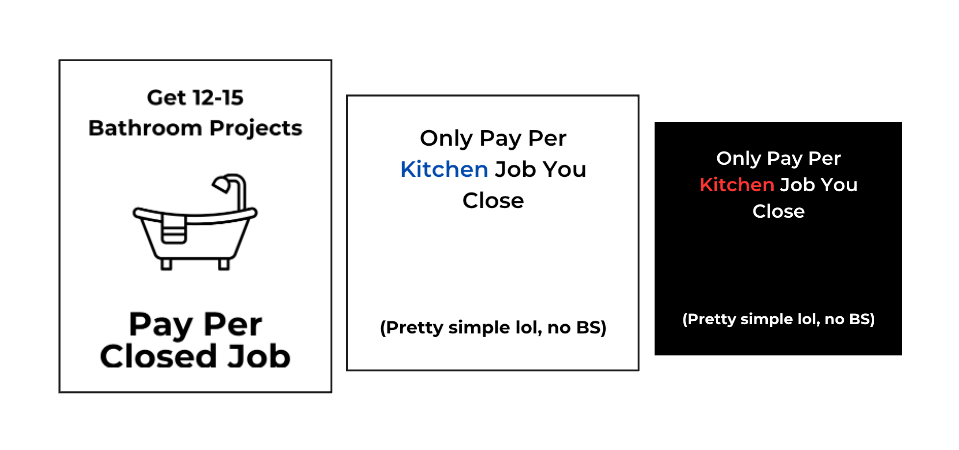
The Angle Mapping Process
Before you ever write a script or create an image, you need to map out all the different reasons someone would buy your product or service. This is called Angle Mapping.
Think back to the dog food example. We didn't start making ads. We first listed every selling point: it's frozen, it's healthy, it doesn't smell, it improves joint health. Each selling point is a potential new concept.
Start with this question: "What are ALL the reasons people would buy my services?"
You can also leverage AI for this. Throw your sales call recordings into an AI tool and ask:
"What are the most common reasons people get on the call? Rank from most to least common all problems people are facing. This is to use as marketing angles in my paid ads."
40+ Angle Examples Across Industries
Here's what real angle mapping looks like:
Med Spa / Aesthetics:
- Tired of patient no-shows and last-minute cancellations
- Need to increase lifetime value of current patients
- Struggling to get positive ROI from marketing spend
- Nurses and aestheticians have schedule gaps
- Want to launch a new high-ticket service (Morpheus8, CoolSculpting)
- Losing patients to an aggressive competitor
- Want to be the #1 premium provider in their city
- Need more cash-pay patients instead of insurance
- Front desk overwhelmed with price-shoppers
- Want to scale to a second location
- Social media looks unprofessional
B2B Coaching / Consulting (Agency Owners): 12. Can't consistently sign high-ticket clients 13. Trapped in feast-or-famine revenue cycles 14. Working too many hours in delivery, not enough on growth 15. No predictable system for generating qualified calls 16. Team is unproductive, needs constant hand-holding 17. Profit margins shrinking 18. Stuck at a revenue plateau ($25K/month ceiling) 19. Imposter syndrome — afraid to charge what they're worth 20. Want to build a personal brand that attracts clients 21. Dealing with demanding, energy-draining low-quality clients 22. Need to productize their service and build scalable systems
E-Commerce (DTC Supplement Brand): 23. Desire for sustained energy — combat the 2 PM slump 24. Fear of cognitive decline and memory loss 25. Persistent brain fog and lack of mental clarity 26. Want a natural alternative to caffeine and energy drinks 27. Need to improve sleep quality 28. Looking for a competitive edge in career or athletics 29. Want to proactively support long-term brain health 30. Frustrated with supplements that have side effects or zero results 31. Product made from clinically-proven, transparently-sourced ingredients 32. Product is convenient for busy lifestyles 33. Investing in health as self-respect and future-proofing
Dog Grooming Service: 34. Dog is heavily matted — worried about pain 35. No time or energy to bathe dog at home 36. Dog gets anxious during grooming — need a patient groomer 37. Want a stylish, breed-specific haircut 38. Shedding out of control — need de-shedding treatment 39. Concerned about harsh chemicals in grooming products 40. Need easy online scheduling 41. Dog has sensitive skin — need hypoallergenic products 42. Want mobile grooming that comes to the house 43. Want to treat dog to a luxurious spa day
Each of these is a new concept. Each one is a different reason to buy. Each one is a unique signal for Andromeda to test against different audience segments.
FAQ: Are Variations Dead?
Does this mean variations are completely dead?
No. But their role has fundamentally changed. Think of it in two phases:
Phase 1 — Exploration (Finding the Gold Mine): Test completely new concepts. Cast a wide net to discover which core angles resonate with the market. Focus 100% on new concepts in this phase.
Phase 2 — Exploitation (Digging for Gold): Once you have a winning concept — an ad that clearly outperforms — then create variations to scale it. Test different hooks, headlines, CTAs, and visuals around that proven winning angle.
The old way was starting with exploitation (testing variations of an unproven idea). The new way is starting with exploration (testing new concepts) and then moving to exploitation once you have a winner.
What do I do when I find a winning ad?
Double down and scale it with variations. For example, if "Tired of patient no-shows" wins for your med spa offer:
- Video testimonial — A med spa owner talking about eliminating no-shows
- Statistic-based ad — "Our clients reduce patient no-shows by 87%"
- How-to ad — Short video explaining the three steps to confirm appointments
- Pain agitation ad — "Each No-Show Costs You $250. Here's How to Stop the Bleeding."
All variations of the same winning concept. This lets you saturate the market with a message you know works while providing enough diversity to keep Andromeda happy.
Campaign Structure: The Chad Media Buyer Approach
In the Andromeda era, the most effective media buyers aren't the ones spending hours tweaking campaigns and analyzing spreadsheets. They're the "Chad media buyers" who understand that creative is the only lever that matters.
Media buying is 10% of your success. The other 90% is creative, copy, and funnel. We CHADVERTISE, we don't GEEKVERTISE.
The Recommended Structure
For most businesses, one consolidated campaign structure. Give Meta's AI as much data and flexibility as possible. The more you try to control the algorithm, the more you limit its performance.
$100+/day budgets:
- CBO (Campaign Budget Optimization) — one campaign
- One ad set — broad targeting (no interests, basic demographics only)
- 30-50 ads in that single ad set — all unique concepts
- 5 ad copies, 5 headlines
- Individual ads (not Dynamic Creative Testing)
Sub-$100/day budgets:
- Same principles, scaled down
- 8-12 creatives
- Still broad, still CBO
Key Principles
- Consolidate with CBO. Set budget at the campaign level. Let Meta dynamically allocate spend to winners in real-time.
- Go broad or go home. No layered interests. No lookalikes. Open audience with basic demographic filters. The creative is the targeting.
- Load up your ad sets. Don't be afraid of 30, 50, or more concepts in a single ad set. Andromeda is designed to handle this volume.
- Trust the algorithm. Your job is not to be a master of targeting. Your job is to be a master of creative. Feed the machine and it will reward you.
What This Means for Agencies
If you run a marketing agency charging for "media buying" — pivot. Fast.
The service you're selling is becoming a feature inside the ad platform itself.
The Old Agency Model (Dying)
- Charge $2K-$5K/month for campaign management
- Deliverable: campaigns running, weekly reports
- Value prop: "we know the platform better than you"
- Margin: eroding as clients realize they can click "Advantage+" themselves
The New Agency Model (Thriving)
- Charge $5K-$15K/month for creative strategy + AI operations
- Deliverable: 50+ unique creative concepts/month, offer positioning, funnel optimization
- Value prop: "we produce the diverse creative and data infrastructure Andromeda needs to perform"
- Margin: expanding because creative production scales with AI tools
The pivot is from platform operator to creative strategist + AI operator.
The Three Things That Actually Matter Now
1. Creative Volume and Diversity
When the algorithm handles distribution, the only variable you control is what you show people. This means:
- Creative volume — producing 30-50+ unique concepts per month, not 5-10 variations
- Creative diversity — genuinely different angles, formats, and emotional triggers
- Creative velocity — testing and iterating daily, not weekly
The winner isn't the one with the best audience. It's the one with the best creative pipeline.
2. Offer Economics Beat Campaign Mechanics
No amount of media buying skill can save a bad offer. A $297 course competing against 10,000 other $297 courses will always have margin pressure.
But a $5,000/month retainer with 80% margins? The math works even at a $200 CPA.
The highest-leverage thing you can do for ad performance is build a better offer. Not a better campaign. A better offer.
3. First-Party Data Is the Moat
Cookies are dead. Third-party data is unreliable. The businesses winning in 2026 feed Meta's algorithm the best first-party data:
- Conversion API (CAPI) sending server-side events
- Customer list uploads for enriched matching
- CRM data integration feeding purchase and LTV data back to the pixel
- Offline conversion tracking connecting calls and sales to ad clicks
If your CRM doesn't talk to your ad platform, you're flying blind.
Why Cook.ai Built a Meta Integration
We didn't build a "media buying tool." We built a Meta Verified Integration that solves the exact problem Andromeda created: the need for massive creative volume and diversity.
Cook.ai's Meta integration handles:
- Creative generation at scale — AI agents produce dozens of genuinely unique ad concepts from your offer data, brand assets, and angle mapping — not 5 variations of the same hook
- Performance analytics — real-time campaign data from Meta's API, analyzed by AI agents who flag what's working and what's not
- Angle discovery — AI agents analyze your sales calls, reviews, and competitor ads to find new concepts you haven't tested
- Campaign recommendations — AI agents suggest budget shifts, creative swaps, and offer changes based on Andromeda-era best practices
The AI agent sees your ROAS drop at 2 AM and adjusts. A media buyer sees it at 9 AM — seven hours of wasted spend later.
The Uncomfortable Truth
Your platform skills are depreciating assets. The audience building you mastered in 2020? Deprecated. The bid strategy frameworks from 2022? Automated. The campaign structures from 2024? Simplified into a single toggle. The 5-hooks-on-1-body playbook? Andromeda groups them as one concept.
But your strategic skills are appreciating assets. Understanding customer psychology, mapping angles, crafting compelling offers, directing diverse creative that converts, building data infrastructure — these skills are worth more in 2026 than they've ever been.
The media buyer who evolves into a creative strategist and AI operator will thrive. The one who clings to manual campaign management will be replaced by a button Meta already built.
Conclusion: The New Media Buying
Media buying isn't dead in the sense that businesses stopped advertising. Businesses will spend more on Meta in 2026 than ever before.
What's dead is the role as it existed from 2015-2024 — the human who manually manages campaigns as their primary value-add.
What replaced it:
- Creative strategy — new concepts, not variations
- Angle mapping — finding every reason someone would buy
- Offer engineering — building offers with economics that support scale
- Data operations — feeding the algorithm first-party signals
- AI operations — directing the agents that produce and optimize everything
The manual labor of media buying was never the value. It was always a means to an end. Now Andromeda handles the means. Your job is to feed it diverse creative and define the end.
Stop buying media. Start feeding the machine.
Cook.ai's Meta Verified Integration generates diverse ad concepts at scale using AI agents — exactly what Andromeda rewards. Creative generation, angle mapping, and campaign optimization on autopilot.
Get Started with Cook.aiFrequently Asked Questions
What is Meta's Andromeda system?
Andromeda is Meta's AI-powered ad retrieval system that sifts through tens of millions of ads to determine which ones get shown. It was built to handle the massive surge in AI-generated creative volume. Andromeda groups similar ads together, which means slight variations of the same concept are treated as one signal — making true creative diversification the key to winning.
What is the difference between a new concept and a variation in Meta Ads?
A new concept is a completely different psychological angle, selling proposition, or ad format — like switching from 'our product improves joint health' to 'our product doesn't smell like other dog food.' A variation is a small tweak to an existing ad: different headline, different background color, different call to action. Andromeda groups variations together, so they compete against each other instead of expanding your reach.
How many ad creatives should I run per campaign in 2026?
For budgets of $100+/day, we recommend 30-50 unique ad concepts in a single ad set using Campaign Budget Optimization (CBO) with broad targeting. For sub-$100/day budgets, 8-12 creatives with the same principles. The key is that these should be genuinely different concepts, not variations of the same ad.
Is media buying really dead in 2026?
The traditional media buyer role — manually setting up campaigns, split-testing audiences, and adjusting bids — has been automated by Meta's Advantage+ and Andromeda systems. What remains is creative strategy, offer engineering, and AI operations. The winners aren't the best button-pushers. They're the ones who can produce diverse, high-quality creative at scale.
How does Cook.ai help with Meta Ads and Andromeda?
Cook.ai is a Meta Verified Integration partner that generates diverse ad creative at scale using AI agents. Instead of manually producing 5 variations of the same concept, Cook.ai's agents can generate dozens of genuinely unique concepts — different angles, formats, and psychological triggers — which is exactly what Andromeda rewards.