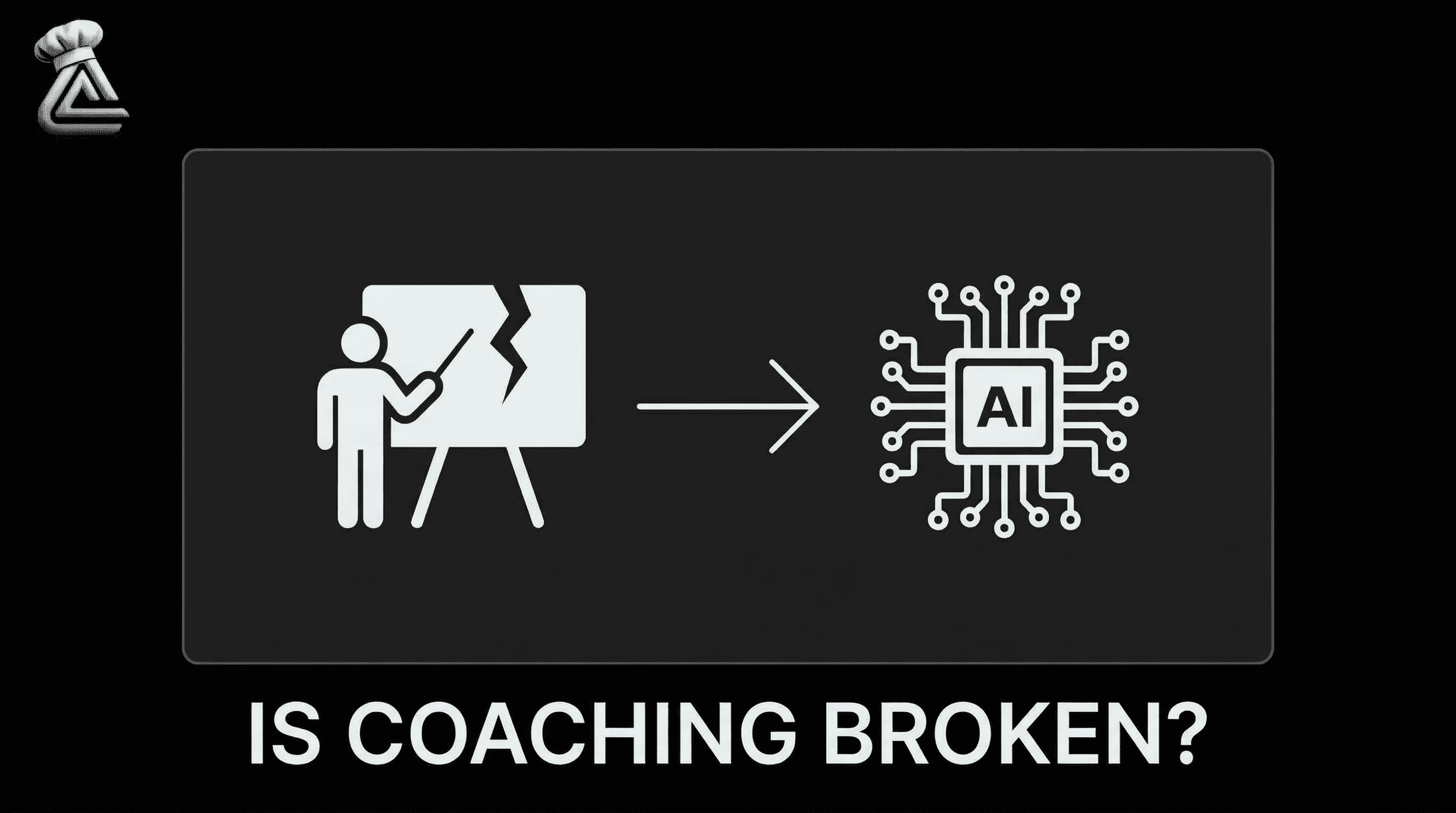
Is The Coaching Model Broken? Why $100M Founders Are Pivoting To AI
The traditional high-ticket consulting model is failing. Discover why industry titans are shifting from selling advice to licensing AI assets.
If you run a coaching or consulting business and haven't hit the nine-figure mark yet, you need to stop and look at the landscape. The tectonic plates of the industry are shifting.
We recently hosted Tanner Chidester, founder of Elite CEOs, who has generated over $111 million in sales over the last six years. While those numbers are impressive, what’s more important is the hard reality he validated—a reality Serge Gatari has been warning about for months.
The traditional coaching model is fundamentally broken.
If you are paying attention, you’ll notice a pattern. The biggest names in the space—Alex Hormozi, Sam Ovens, and now Tanner Chidester—are pivoting. They are moving away from pure services and information products into software, SaaS, and equity. They aren't doing this because they are bored. They are doing it because they hit the ceiling of a flawed business model.
Here is why the old way of selling advice is dying, and how building AI assets is the only viable path forward.
The "Info-Chasm" and Why Churn is Inevitable
Tanner Chidester didn’t start at the top. He spent years grinding, selling a $47 fitness program called the "Rapid Muscle System" and making zero traction. It wasn't until he raised his prices to $1,500 and started selling over the phone that he cracked the code, scaling from zero to $1 million in 22 months.
But scale revealed the cracks in the foundation.
In the information space, you are fighting a losing battle against value decay. When you sell knowledge, the moment the client consumes that knowledge, its value drops to zero.
"The issue with information is once someone acquires the information, it is no longer valuable... They blame the person who gave the info even though the info is the same." — Tanner Chidester
This creates a revolving door. You are forced to constantly acquire new customers to replace the ones who learned what you taught them and left. It is a hamster wheel. You aren't building an asset; you are just working a high-paying job with massive overhead.
Serge Gatari puts it bluntly:
"Information is good when it comes to scalability, but when it comes to recurring value, it is the worst... As soon as you consume it, it is useless."
The Fulfillment Trap: Why Scaling Sucks
The second reason the model is broken is the fulfillment trap.
In a service business, revenue growth usually correlates linearly with headcount growth. To make more money, you need more account managers, more coaches, and more support staff. Your margins get squeezed, and your headaches multiply.
Tanner noted that at his peak, generating massive monthly revenue, his take-home profit percentage dipped significantly because of the infrastructure required to support it.
If your business gets harder to run the bigger it gets, you don't have leverage.
Software companies (SaaS) don't have this problem. If Netflix adds 100,000 users overnight, they don't need to hire 100,000 employees to mail out DVDs. The product fulfills itself.
This is why the titans of the industry are leaving coaching for software. They want leverage. They want a product where the 1,000th customer costs the same to fulfill as the first one.
The Pivot: From Advisor to Asset Builder
So, what do you do if you are a consultant or agency owner? You probably aren't a coder, and you don't have the capital to acquire a SaaS company.
The answer lies in AI and Asset Licensing.
Serge identifies the massive opportunity currently sitting in front of every knowledge worker. You must stop selling advice and start selling assets.
Instead of teaching a client how to write a high-converting ad (advice), or writing the ad for them manually (service), you build a system—an AI agent—that writes the ad for them based on your proprietary frameworks (asset).
The Hierarchy of Value
- Do It Yourself (Course): Client buys info, does the work. High failure rate. High churn.
- Done With You (Coaching): Client gets guidance. Better results, but still relies on client effort.
- Done For You (Agency): You do the work. High results, but unscalable fulfillment.
- AI/Asset ( The New Model): The system does the work. Instant results. Zero marginal cost.
"If you believe you can make millions online without having a unique mechanism, a unique protocol, and preferably a fulfillment model that gives you an edge over everyone else, you’re delusional." — Serge Gatari
When you productize your knowledge into an AI workflow, you create a moat. You are no longer competing with thousands of other coaches selling the same generic advice. You are selling a proprietary tool that delivers a result.
Lessons from $111 Million in Sales
Tanner’s journey offers critical tactical lessons for anyone looking to transition from a grinder to a business owner.
1. Scare Your Hires Away
Most founders try to sell the dream during job interviews. Tanner does the opposite. He actively tries to scare candidates away.
"I want to scare people off... I tell them, 'We work really hard, no days off, we're very competitive here. If you're not into that, you're not going to like it.'"
If you hire for potential, you end up doing the job for them. Hire for experience. Hire people who have already done the thing you need them to do.
2. The Power of "Cash on Hand"
In sales, logical selling beats emotional selling at scale. Tanner’s approach to handling the "I don't have the money" objection is a masterclass in logic. instead of asking "how does that make you feel," he asks for cash on hand.
If a prospect says they can't afford a $10k program, don't drop the price immediately. Ask what they can spend today. If they have $5k liquid, take the $5k, get them started, and work out the rest. Maximize cash collection, don't maximize accounts receivable.
3. Paid Ads vs. Organic: The Trust Equation
Tanner built his empire on paid ads, spending millions. But he admits the landscape has changed. Paid ads are becoming commoditized and expensive.
Organic content builds trust that paid ads cannot buy.
In a market flooded with "gurus," trust is the currency. If you can acquire attention for free (organic) and convert it using automated systems (AI), you have an infinite ROI business model.
Why "Done-For-You" via AI is the Endgame
Tanner pointed out that the businesses that exited for hundreds of millions or billions—like Weedmaps or Byte (the Invisalign competitor)—had one thing in common: Low to Zero Fulfillment.
Byte sold for over a billion dollars. They weren't teaching people how to straighten their teeth. They shipped a product, the customer used it, and the result happened.
As a consultant, you can achieve this by turning your SOPs into AI agents.
- The Old Way: You teach a client how to scrape leads.
- The New Way: You license an AI bot that scrapes, qualifies, and enriches leads for them automatically.
This shifts your business from a service revenue model to a usage-based revenue model. You get paid every time the system runs. That is recurring revenue. That is an asset.
Conclusion: Adapt or Die
The golden age of selling generic information is over. The market is too sophisticated, and the competition is too fierce.
If you want to survive, you must stop being a "coach" and start being an architect of outcomes. You need to take your intellectual property, codify it, and deploy it via AI.
This doesn't mean you stop serving clients. It means you change how the value is delivered. You move from labor-intensive delivery to software-driven delivery.
As Tanner Chidester realized after $111 million in sales: Regret stems from lack of effort. But burnout stems from a lack of leverage.
Don't wait for the industry to leave you behind. Audit your current fulfillment process. Find the repetitive tasks you are teaching or doing manually. That is your roadmap for your first AI asset.
Ready to turn your consulting IP into a scalable AI asset?
Cook.ai helps high-ticket businesses automate their fulfillment and operations, transforming service businesses into scalable tech-enabled hybrids.
[Click here to learn more about implementing AI in your business]
Cook.ai helps high-ticket businesses automate their entire growth layer with AI.
Get Started with Cook.aiFrequently Asked Questions
Is the coaching business model dying?
The traditional model of selling courses and group calls is becoming unsustainable due to market saturation and AI alternatives. However, coaches who pivot to AI-enhanced delivery — using automation, AI agents, and productized services — can scale beyond what was previously possible.
How are top coaches using AI in their business?
They're licensing AI-powered tools and systems to clients, using AI agents for sales follow-up and client onboarding, automating content creation, and building productized services that deliver results without trading time for money.
Can I white-label AI tools for my coaching clients?
Yes. Platforms like Cook.ai offer white-label AI tools including sales agents, CRM, funnel builders, and content creation — allowing coaches and consultants to charge $997-$2,997/month per client for branded AI-powered systems.