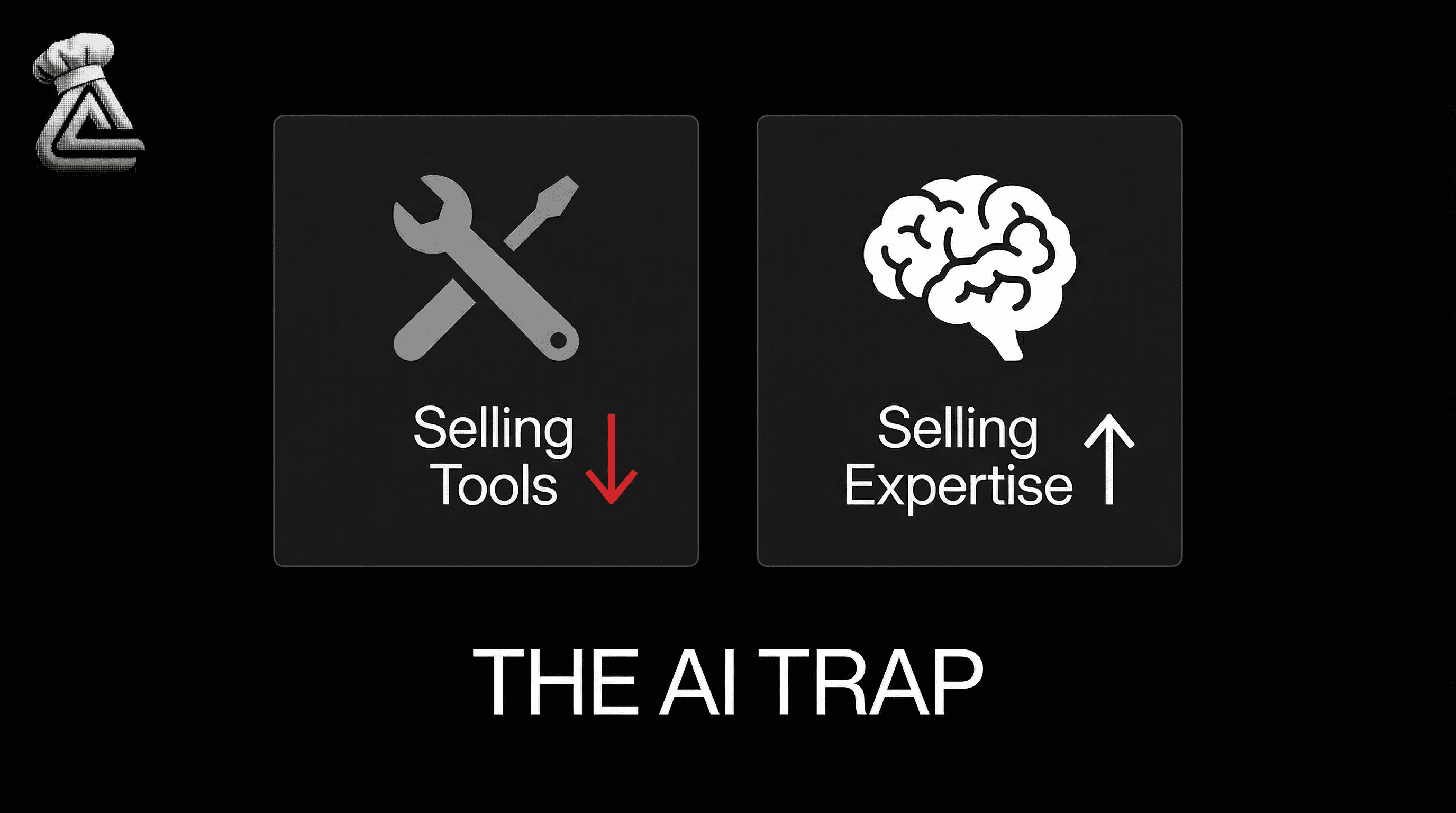
The AI Trap: Why Selling Tools Won't Make You Rich (And What Will)
Stop selling AI tools. Learn why the real money is in vertical integration and niche expertise, and how to avoid becoming obsolete in the AI race.
The last 12 months have been a blur of noise. Every time you open Twitter or YouTube, you are bombarded with a new tool, a new wrapper, or a new guru telling you how to get rich quick by reselling ChatGPT.
But amidst the hype cycle, there is a fundamental economic question that very few people are asking, and even fewer are answering honestly.
It is the question that I, Serge Gatari, have spent the last year obsessed with. It is the question that determines whether your business survives the next five years or fades into obscurity.
That question is: How do you make money selling something that is essentially free?
Because that is what AI is. Intelligence is becoming abundant. It is becoming a commodity. And if you are trying to sell a commodity, you are in a race to the bottom.
If you want to build something durable—a business that generates millions in profit rather than a side hustle that makes a few grand for six months—you need to stop playing the game everyone else is playing. You need a different mental model entirely.
The Commodity Trap: Why Tools Are Worthless
The AI hype is so deafening that it is incredibly difficult to distinguish what is valuable from what is, frankly, a scam.
There is so much noise that even experts running seven-figure companies struggle to see the signal. But here is the reality check: No one wants to buy your AI chatbot.
Why? because the underlying technology is becoming accessible to everyone. The providers of these tools—the companies charging you $29 or $50 a month—are selling pickaxes during a gold rush. But for you, the agency owner or the consultant, simply reselling those pickaxes is a dead end.
"The AI hype is so huge that it's really hard to see what's valuable from what's just pure scam bullshit in the entire industry."
If your entire value proposition is that you know how to use a tool that creates AI voice agents or chatbots, you are on a timer. How long until your clients realize that what you are selling them is ubiquitous? How long until a platform creates a native integration that does exactly what you do, but for free?
The tools themselves are commodities. A commodity, by definition, has a value that approaches the cost of production. And the cost of producing intelligence is dropping to zero.
So, if the tools aren't worth anything, where is the value?
The Real Opportunity: Expertise Over Algorithms
This brings us to the second, more important question: Who is best positioned to make the most money with AI?
Most people think it’s the tech-savvy kid who knows how to code python or the growth hacker who knows how to string together a Zapier workflow.
They are wrong.
The person best positioned to win is not the generalist. It is the expert.
It is the person who understands a specific industry so deeply that they know exactly where the bodies are buried. It is the person who knows the specific pain points of a dental practice, a heavy equipment leasing firm, or a high-ticket coaching business.
AI is a force multiplier. But 100x multiplied by zero is still zero. If you don't have deep industry knowledge, you have nothing to multiply.
"The tools alone are worth nothing... The thing that will make the tools valuable is the person who has the best insights, the best knowledge on how to get these tools to provide the most amount of value for the right person."
This is the uncomfortable truth that the "get rich quick" crowd doesn't want to hear: The people making the most money with AI are the ones who were already good at something else. They aren't newbies. They are experts leveraging new tech to solve old problems faster and cheaper.
The New Playbook: Vertical Integration
So, if you want to escape the commodity trap, you need a new playbook. You cannot just be an "AI Automation Agency." That is too broad. It means nothing.
Here is the exact framework we are using at Cook.ai to help our clients scale from zero to $100k/month.
1. Pick a Vertical and Obsess Over It
Generalists get paid in peanuts; specialists get paid in gold. You need to pick a niche—a market, a vertical—where there is real pain and real money.
This could be HVAC companies, private equity firms, info-product businesses, or medical clinics. It doesn't matter what it is, as long as you commit to it.
2. Find the 1% and Study Them
This is the step everyone skips. Do not try to invent a solution from scratch. You are not smarter than the market.
Instead, go find the top 1% of performers in that specific niche. Find the guy who is crushing it. Then, ruthlessly deconstruct their operation.
- How are they getting leads? Is it YouTube ads? Cold email? Partnerships?
- What is their funnel? Do they send traffic to a webinar? A VSL? A lead form?
- How do they sell? Do they have a call center? Is it a high-ticket consultative close? Do they use a simple checkout page?
- How do they fulfill? What happens after the payment is made?
"I want to go find who is the one percent in every one of these niches? And then I want to figure out what is their playbook?"
You need to study them like a scientist. Understand the physics of their business.
3. Automate the Winning Workflow
Once you have the blueprint of the 1% performer, your job is simple: Democratize it.
Take that high-performing workflow—the proven ads, the scripts, the follow-up sequences, the fulfillment logic—and build it into an AI infrastructure.
You are not selling "AI." You are selling the result that the top 1% achieve, packaged in a way that the other 99% can afford and implement.
You ask yourself: "How do I implement this playbook for the remainder of the market that's struggling to make money in that same niche?"
This is how you get businesses to pay you thousands of dollars a month. You aren't selling a chatbot; you are selling a system that turns strangers into customers, based on a proven model, powered by AI.
Phase 2: From Service to Platform
There is a second phase to this evolution.
Right now, integration is valuable. Companies need help wiring these systems together. But eventually, even integration services will face downward price pressure.
The endgame is productization.
You take the service you have been manually integrating—the workflow you perfected for your niche—and you turn it into a self-serve software platform.
This is how you build equity. This is how you build an asset that sleeps while you make money. You move from being a high-paid consultant to a software owner.
"The end playbook is going to be to productize this and create an app that does it in an automated way, in a self-serve way."
We are already seeing this happen. The smart agencies are morphing into SaaS companies. They are taking their proprietary workflows and wrapping them in code. If you don't do this, someone else will. And when they do, your service business will be rendered obsolete.
The Race to Survival
Let’s zoom out. Why does this matter? Why am I speaking about this with such urgency?
Because this isn't just about making money. It is about survival.
AI is essentially a massive deflationary force on human incompetence. For a long time, businesses (and people) could get away with being mediocre because there was no alternative. You could charge high fees for slow, inefficient work because the friction of replacing you was too high.
That friction is gone.
"It's either you're going to replace people, or people are going to replace you... It's not a zero-sum game? Unfortunately, for the first time ever, it kind of is."
If a platform can do 90% of what you do for 1% of the cost, you are finished. No business owner, no matter how loyal, will continue to pay you $5,000 a month for something they can get for $50 a month.
Obsolescence is real.
If you do not learn how to integrate these systems, if you do not learn how to productize your expertise, you will be left behind. This is a race to survival.
The Verdict
The opportunity with AI is massive, but only if you respect the dynamics of the market.
- Stop selling tools. Tools are free.
- Sell outcomes. Outcomes are valuable.
- Specialize. Generalists die.
- Productize. Services eventually get commoditized.
We are entering an era where small teams can generate massive output. We have clients scaling from zero to $25k, $50k, even $100k a month in record time because they aren't just "using AI." They are solving expensive problems for specific industries using AI as the lever.
We are building the roadmap for this at Cook.ai. We are identifying the 1% playbooks, building the infrastructure, and helping our partners own entire verticals.
The window to establish yourself as the dominant player in your niche is open, but it is closing fast. The technology is moving too quickly for you to sit on the sidelines.
Don't be the person who got replaced. Be the person who did the replacing.
Cook.ai helps high-ticket businesses automate their entire growth layer with AI.
Get Started with Cook.aiFrequently Asked Questions
Why is selling AI tools a bad business model?
AI tools are commoditizing rapidly. When anyone can access the same tools, your margin disappears. The value is in the expertise and outcomes you deliver using AI, not the AI itself.
What should AI agencies sell instead of tools?
Sell outcomes and vertical expertise. Package AI into a done-for-you service or productized offer that solves a specific problem for a specific niche. Charge $3K–$10K+ per month for the result, not the technology.
How do I position myself as an AI expert rather than a tool reseller?
Pick a niche, build case studies showing measurable outcomes, and package your service as a complete solution. Cook.ai helps you build the offer, sales funnel, and automation to support high-ticket positioning.