The $16 Trillion Opportunity Hiding in Plain Sight
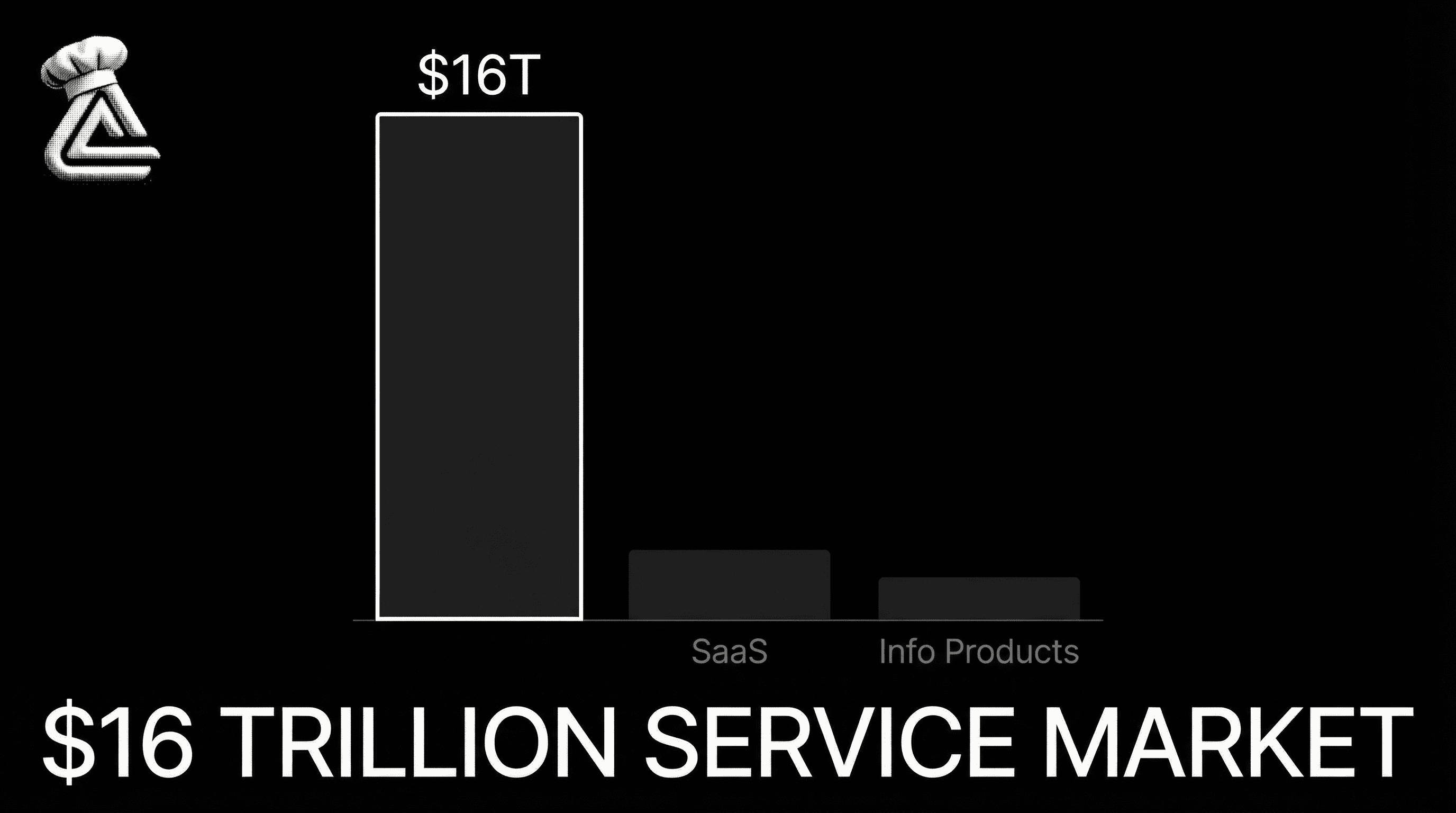
While everyone chases SaaS or info-products, the global service market is worth over $16 trillion. Here is why AI automation in services is the real frontier.
If you look at the headlines, you’d think the entire world revolves around SaaS (Software as a Service) or the creator economy. Every guru on your timeline is telling you to build a software company or launch a course. They tell you that’s where the money is.
They are wrong.
They aren't just slightly off; they are missing the forest for the trees by a magnitude of 25x. While the tech world obsesses over valuations in the software sector, the real money—the cash that actually moves the global economy—is sitting in a completely different bucket: Services.
In a recent breakdown of market dynamics, Serge Gatari dropped a reality check that every high-ticket coach, consultant, and agency owner needs to hear. The opportunity isn't in selling information. It isn't even necessarily in building new software.
The opportunity is in using AI to revolutionize the $16 trillion global service market.
The Math That Breaks the Narrative
Let’s look at the numbers. We often get blinded by the massive exits of Silicon Valley unicorns, leading us to believe that the software market is the biggest pie on the table.
Here is the reality check Serge Gatari provides:
"The software market right now is a little over 650 billion market cap. But the service world globally is over 16 trillion market a year. That’s 16,000 billions."
Let that sink in.
The software industry—Microsoft, Oracle, Salesforce, and every SaaS startup clamoring for attention—combined makes up a fraction of the economic volume of the service sector. Software is a tool. Services are the execution.
When a business has a problem, they might buy software ($650B market). But more often, they pay a human, an agency, or a firm to actually solve the problem using that software. That is the service layer. And it is gargantuan.
The "Info-Product" Trap
This distinction becomes even more critical when we look at the "Education" or "Info-product" space. If you are in the high-ticket coaching or consulting world, you constantly hear about the booming e-learning market.
People hype the information market as the next gold rush. They tell you it's going to be a $300 billion industry. And sure, $300 billion is a lot of money. But compared to the service sector?
"You know how people say, 'Oh, but the info market is so big, it’s going to be like 300 billion'? ... I'm like, yeah, but there is 16,000 billion out there in all the different verticals and niches where AI could potentially revolutionize."
If you are pivoting your entire business to sell a course because you think "services don't scale," you are walking away from a $16 trillion feast to fight over scraps at a $300 billion table.
Why the Service Market is Ripe for Disruption
Why is the service market so big? Because it is inefficient.
That $16 trillion represents trillions of hours of human labor. It represents lawyers drafting contracts, accountants categorizing expenses, marketing agencies writing copy, consultants analyzing data, and operations managers moving tickets from column A to column B.
Historically, the reason investors loved software and hated services was scalability.
- Software: Write code once, sell it a million times. (High Margin, Infinite Scale).
- Services: Sell an hour of time, deliver an hour of time. (Lower Margin, Linear Scale).
But Artificial Intelligence has fundamentally broken this binary.
AI allows services to scale like software.
This is the core of the opportunity Serge is pointing toward. We are moving into an era of "Service-as-Software." You can now run a high-ticket service business where the fulfillment—the actual work being done—is executed by AI agents, automations, and LLMs, not just an army of humans.
When you apply AI to that $16,000 billion market, you aren't just making it slightly better. You are unlocking margins that were previously impossible.
The Three Tiers of Market Value
To understand where to position your business, you need to understand the hierarchy of value in this new economy.
1. The Software Layer ($650B)
This is the infrastructure. The databases, the CRMs, the hosting. It’s crowded, competitive, and dominated by massive incumbents. Unless you are an engineer with a groundbreaking proprietary algorithm, this is a hard game to win.
2. The Information Layer ($300B)
This is the "How-To" economy. Courses, masterminds, and content. It is valuable, but it suffers from high churn and market fatigue. Information is becoming a commodity. As AI makes knowledge free and instant (thanks to tools like ChatGPT and Perplexity), the value of "selling information" drops. Why pay $2,000 for a course on copywriting when an AI can just do the copywriting?
3. The Service Layer ($16T)
This is the "Done-For-You" economy. This is where the client pays for a result, not a tool or a tutorial.
In the past, this was the hardest layer to scale because it required people. Today, it is the most lucrative layer because it commands the highest prices (High-Ticket) and can now be fulfilled automatically (High-Leverage).
Identifying the "16,000 Billions" in Your Niche
Serge mentions that this money is spread out across "all the different verticals and niches." This is key. The $16 trillion isn't in one pile; it's hidden in thousands of boring, unsexy industries.
It’s not just about "AI Marketing Agencies."
- Legal Services: Automating contract review and discovery.
- Healthcare Admin: Automating patient intake and insurance claims.
- Logistics: Automating dispatch and route optimization.
- Recruiting: Automating candidate sourcing and initial screening.
- Financial Consulting: Automating tax planning and audit prep.
If you run a high-ticket business, stop trying to turn your service into a low-ticket course. Instead, use AI to turn your service into a high-margin machine.
The Shift from "Consultant" to "Architect"
The winners of this next cycle won't be the ones who know the most (Info) or the ones who code the best (Software). The winners will be the Architects who can stitch together AI tools to solve expensive problems for businesses in the service sector.
If you are a consultant, don't just teach your clients how to solve a problem. Build the AI system that solves it for them. That is how you tap into the $16 trillion market cap.
How to Capitalize on This Right Now
So, how do you actually take a bite out of this $16 trillion apple? You need to restructure how you view your delivery mechanism.
1. Audit Your Service Delivery Look at every step of your fulfillment process. Where are you or your employees spending time? Is it data entry? Is it research? Is it synthesis? If a human is doing it, it's costing you margin. If an AI does it, it's almost pure profit.
2. Productize the Outcome Stop selling "hours." The service market is valued at $16T because people pay for time. But if you decouple time from value, you win. Sell the outcome. If you can deliver a $10,000 outcome in 5 minutes using AI, you keep the $10,000. If you do it manually and it takes 50 hours, you burned your profit.
3. Ignore the Hype, Follow the Cash While your competitors are trying to become influencers or launch the next SaaS wrapper, look at boring, cash-rich service industries. Look for friction. Look for high labor costs. That is where AI yields the highest ROI.
Conclusion: The Revolution is Service-Based
Serge Gatari's message is clear: Don't get distracted by the shiny objects.
The software market is great. The info market is fine. But the service market is the ocean. It is where the global economy lives and breathes.
We are standing on the precipice of the biggest transfer of wealth in history, driven by the automation of the service sector. There are 16,000 billion reasons to stop worrying about selling courses and start focusing on automating results.
The technology is here. The market is waiting. The only question is whether you will be the one to automate it, or if you will be the one replaced by it.
Ready to stop trading time for money and start tapping into the $16T service economy? At Cook.ai, we help high-ticket businesses deploy the AI infrastructure needed to scale without limits. Let's get to work.
Cook.ai helps high-ticket businesses automate their entire growth layer with AI.
Get Started with Cook.aiFrequently Asked Questions
How big is the global service market?
The global service market is worth over $16 trillion annually. This includes consulting, professional services, coaching, marketing, legal, accounting, and other service-based industries.
Why are AI-powered services a better opportunity than SaaS?
Services have higher margins, less competition from venture-funded startups, and a massive addressable market. AI makes services scalable — you can deliver personalized results to more clients without proportionally increasing your team size.
How do I start an AI-powered service business?
Pick a niche in the service market, build a high-ticket offer ($3K-$10K+/month), use AI tools to automate delivery and sales, and position yourself as the AI-powered alternative to traditional providers. Cook.ai provides the offer builder, CRM, sales agents, and funnel automation to get started.